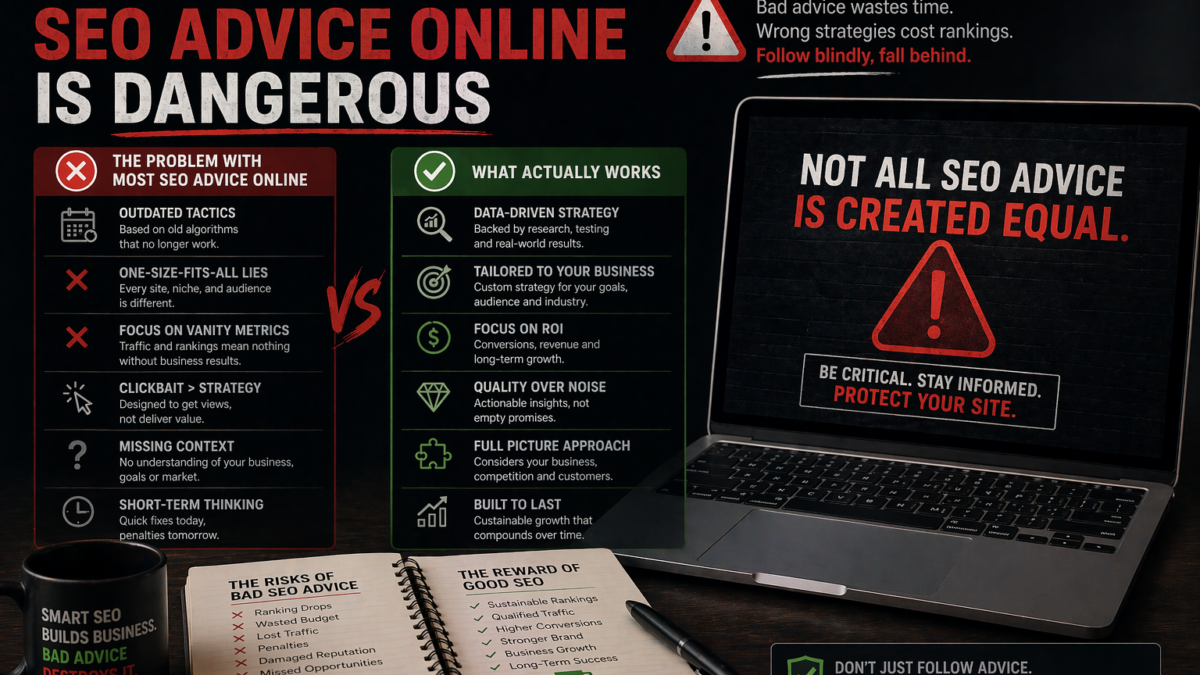
The internet is flooded with SEO advice.
Every day, new threads, videos, and blog posts promise faster rankings, guaranteed traffic, and hidden algorithm “secrets.” For beginners, this feels empowering. For businesses, it creates hope.
However, after years of observing real-world outcomes, one uncomfortable truth becomes clear: most SEO advice online causes more harm than good.
Not because it is intentionally wrong—but because it is incomplete, decontextualized, or dangerously oversimplified.
The Problem Isn’t Misinformation — It’s Missing Context
Most SEO advice is not false. It is partial truth.
Common statements like:
- “Content is king”
- “Backlinks are everything”
- “Just fix technical SEO”
All contain elements of truth. However, without context, they become misleading.
SEO only works when applied:
- To the right website
- In the right market
- At the right stage of growth
This context is almost always missing in online advice.
Generic Advice Ignores Business Reality
SEO content online is often optimized for reach—not accuracy.
As a result:
- Local business strategies get applied to enterprise websites
- Startup tactics are copied by established brands
- E-commerce strategies are used for lead-generation businesses
What works in one model can quietly damage another.
Survivorship Bias Dominates SEO Content
Most SEO case studies show success stories.
They highlight:
- What worked
But ignore:
- What failed
- The sites that collapsed
- The risks that were never taken
This creates a false sense of certainty and predictability.
“Google Loves This” Is Usually Guesswork
Google rarely explains why something works.
Yet, SEO advice often claims:
- “Google prefers long content”
- “Google rewards freshness”
- “Google wants a specific structure”
In reality, Google rewards outcomes—not formulas.
SEO Advice Ages Faster Than You Think
SEO advice has a short lifespan.
Tactics that worked:
- Three years ago
- One year ago
- Even six months ago
May now:
- Have no effect
- Be ignored
- Or even cause harm
Despite this, outdated advice continues circulating without context.
The One-Size-Fits-All Checklist Problem
SEO checklists feel structured and safe.
However, they:
- Do not prioritize
- Do not consider trade-offs
- Ignore opportunity cost
Blindly following checklists often leads to:
- Over-optimization
- Wasted resources
- Missed opportunities
SEO is not a task list—it is a decision-making system.
Why “Quick Wins” Lead to Long-Term Damage
Online SEO advice often promises speed:
- “Rank in 30 days”
- “Instant traffic hacks”
These quick wins usually depend on:
- Temporary loopholes
- Exploitable gaps
- Unsustainable tactics
They work—until they don’t. Recovery is always slower than growth.
Tool-Driven Advice Can Be Misleading
Many SEO articles exist to promote tools.
This leads to:
- Metrics becoming goals
- Alerts creating unnecessary urgency
- Scores replacing judgment
As a result, businesses optimize dashboards instead of outcomes.
Why Beginners Often Give the Loudest Advice
The most confident SEO advice often comes from those early in their journey.
This happens because:
- Early success feels repeatable
- Failures haven’t accumulated yet
- Long-term consequences are not visible
Experience introduces caution—but online platforms reward confidence.
SEO Advice Rarely Mentions Opportunity Cost
Every SEO action has a cost:
- Time
- Budget
- Attention
However, most advice ignores what you are sacrificing to take that action.
This is why businesses that focus on prioritization outperform those following every recommendation.
Algorithm Updates Don’t Break Strategy — Bad Advice Does
After every algorithm update, panic spreads.
New claims appear:
- “Content is dead”
- “Links don’t matter anymore”
- “AI replaced SEO”
Most of this is reactionary noise.
Strong strategies rarely collapse overnight—weak ones do.
SEO Advice Is Made for Creators, Not Businesses
SEO influencers optimize for:
- Engagement
- Virality
- Personal authority
Not for:
- Business constraints
- Risk tolerance
- Internal decision-making
What sounds bold online can be reckless in real-world scenarios.
Why Copying Competitors Is Risky
A common recommendation is: “Do what’s already ranking.”
However, competitors:
- May have authority you don’t
- May take risks you cannot afford
- May already be declining
Imitation delays failure—it does not prevent it.
SEO Requires Diagnosis, Not Prescriptions
Most SEO advice skips the most important step: diagnosis.
Effective SEO begins with:
- Understanding the business model
- Identifying bottlenecks
- Mapping intent gaps
Applying tactics without diagnosis is ineffective.
When SEO Advice Becomes Dangerous
SEO advice becomes harmful when it:
- Encourages shortcuts
- Promises certainty
- Ignores risk
Ironically, these are the same traits that perform best online.
Why Businesses Eventually Move Beyond Online Advice
As businesses grow, they realize:
- Traffic alone doesn’t drive growth
- Rankings don’t satisfy leadership
- Generic “best practices” fall short
At this stage, they shift toward strategy-driven decision-making.
The Hidden Cost of Bad SEO Advice
Bad advice rarely causes immediate failure.
Instead, it leads to:
- Gradual loss of trust
- Increasing technical debt
- Strategic misalignment
By the time the damage becomes visible, fixing it is expensive.
Good SEO Advice Requires a Time Horizon
Effective SEO advice answers:
- For how long will this work?
- At what scale?
- With what level of risk?
Most online advice ignores these critical factors.
Why Experienced SEO Professionals Speak Less
As experience increases:
- Certainty decreases
- Nuance increases
- Public advice becomes harder to simplify
This creates an environment where oversimplified voices dominate.
What Safe SEO Advice Looks Like
Reliable SEO advice:
- Starts with “it depends”
- Explains trade-offs
- Acknowledges uncertainty
It does not promise outcomes—it outlines probabilities.
The Role of Strategic SEO Partners
Businesses that outgrow generic advice need:
- Context-specific strategies
- Risk-aware execution
- Long-term accountability
The difference lies in filtering advice—not blindly applying it.
Conclusion
Most SEO advice online is not malicious—it is incomplete.
It lacks context, ignores risk, and oversimplifies complexity. Following it blindly does not lead to immediate failure—it leads to slow, silent failure.
Real SEO progress comes from asking better questions, understanding trade-offs, and aligning decisions with long-term business goals.
FAQs
Is all online SEO advice bad?
No. However, most of it lacks context and does not account for risk, making it unreliable when applied blindly.
Why does bad SEO advice sometimes work?
Because SEO systems can tolerate inefficiencies for a short period, creating the illusion that flawed strategies are effective.
Should beginners avoid SEO content online?
No. Beginners should use it for learning, but not treat it as direct instruction without understanding context.
What is the safest way to apply SEO advice?
Test cautiously, measure outcomes, and always consider trade-offs and opportunity cost before scaling any strategy.
When should businesses stop following generic SEO advice?
When SEO decisions begin to impact revenue, brand perception, or long-term scalability.
Leave a Reply