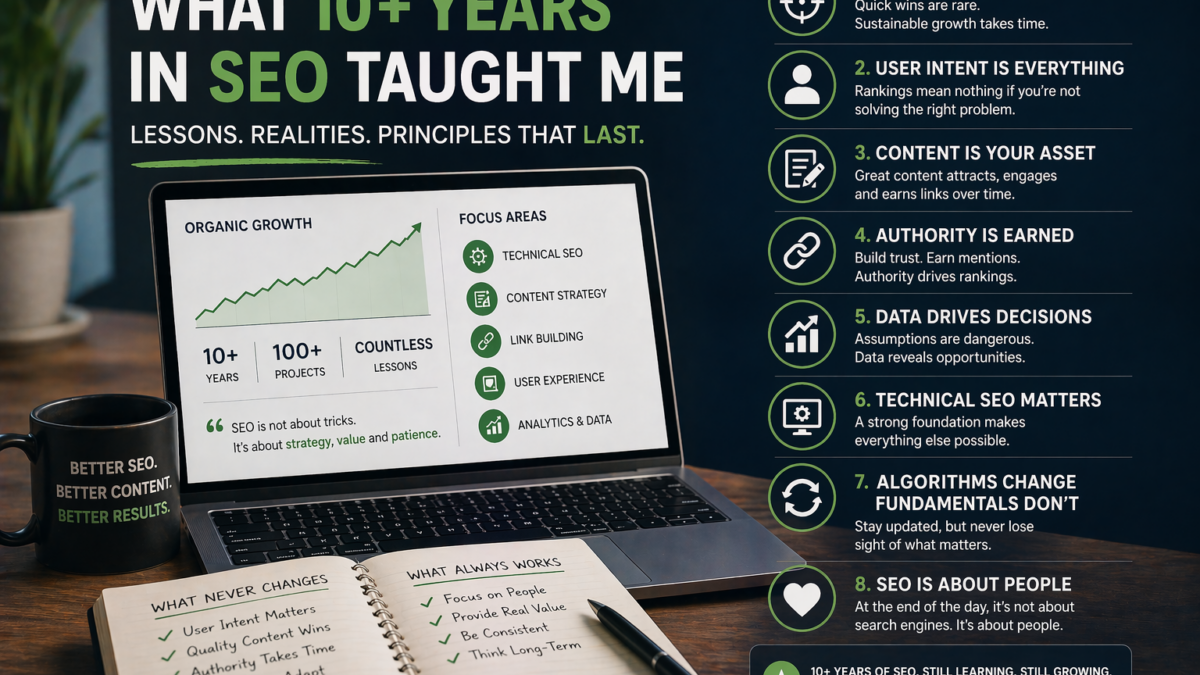
Spending more than a decade in SEO fundamentally changes how you see the industry.
Early on, success feels technical—rankings improve, traffic increases, and dashboards look impressive. However, over time, patterns begin to emerge. Some strategies age well, while others quietly fail. Moreover, many widely accepted “best practices” turn out to be situational at best—and harmful at worst.
This is not a how-to guide. Instead, it’s a reflection on what long-term exposure to SEO teaches about users, businesses, algorithms, and even yourself.
These lessons were not learned from tools or updates—they were learned from outcomes.
SEO Is About People, Not Search Engines
Early-stage SEO often focuses heavily on algorithms.
However, over time, a clearer reality emerges:
- Algorithms change
- User behavior evolves
- Business goals remain
SEO works best when it aligns with how people search, evaluate, and make decisions—not when it tries to manipulate systems.
Shortcuts Always Have a Cost
Every shortcut in SEO works—temporarily.
This includes:
- Aggressive link-building schemes
- Thin content at scale
- Over-optimized pages
While the benefits may appear quickly, the cost always arrives eventually. Sustainable SEO favors restraint over cleverness.
Most SEO Problems Are Strategic, Not Technical
Technical SEO matters—but it is rarely the root issue.
Most failures come from:
- Targeting the wrong keywords
- Misunderstanding search intent
- Chasing traffic instead of outcomes
Fixing strategy often delivers far greater impact than fixing code.
Traffic Is the Easiest Metric to Inflate
One of the biggest realizations over time is this:
Traffic is easy to grow—and easy to misinterpret.
High traffic can still mean:
- Poor lead quality
- Low conversions
- Weak business impact
Experienced SEO professionals stop celebrating volume and start questioning relevance.
SEO Is a Business Discipline
SEO stops being just “marketing” once you’ve seen enough real-world outcomes.
It becomes:
- A decision-support system
- A demand-shaping channel
- A credibility signal
Businesses that treat SEO as part of their core strategy consistently outperform those that treat it as a tactical add-on.
Content Volume Rarely Wins
In the early stages, publishing more content may seem effective.
However, long-term SEO rewards publishing better content.
Sites that scale without depth eventually:
- Cannibalize their own rankings
- Lose topical authority
- Decline gradually
Quality compounds. Quantity decays.
Rankings Are Fragile — Authority Is Not
Rankings fluctuate constantly.
Authority, however, persists.
Over time, it becomes clear that:
- Trusted brands recover faster
- Authoritative sites withstand updates better
- Weak brands lose visibility permanently
SEO durability comes from reputation—not tricks.
Tools Don’t Teach Judgment
Tools can accelerate execution—but they cannot teach decision-making.
True judgment comes from:
- Observing patterns across industries
- Learning from repeated failures
- Knowing when not to optimize
Experience fills the gap that tools never can.
SEO Success Is Often Boring
The most effective SEO strategies are rarely exciting.
They often involve:
- Fixing foundational issues
- Improving existing content
- Avoiding unnecessary changes
There is rarely a dramatic breakthrough—only consistent, incremental progress.
Clients Don’t Care About SEO Language
Technical SEO terminology often means little to clients.
Terms like:
- Crawl budget
- Indexation
- Schema
What clients actually care about is:
- Growth
- Predictability
- Clarity
Translating SEO into business language is one of the most valuable long-term skills.
Not All Growth Is Good Growth
Growth that increases complexity faster than value can be harmful.
Over time, experienced professionals begin asking:
- What will this cost to maintain?
- Does this scale efficiently?
- Will this still make sense in two years?
Sustainable growth always prioritizes longevity over short-term spikes.
SEO Requires Saying “No”
Experience teaches restraint.
You must say “no” to:
- Keyword stuffing
- Low-value content ideas
- Misaligned expectations
Saying yes to everything leads to burnout—and loss of trust.
SEO Is About Trade-Offs
There is no perfect optimization.
Every decision involves trade-offs, such as:
- Speed vs stability
- Volume vs relevance
- Automation vs control
Understanding these trade-offs separates experienced professionals from beginners.
Authority Is Built Outside the Website
On-page SEO alone is not enough.
Search engines evaluate:
- Brand mentions
- Consistency across platforms
- External validation
Strong authority is built beyond your website—not just within it.
SEO Changes — Human Behavior Doesn’t (Much)
Algorithms evolve rapidly.
Human behavior evolves slowly.
Over time, patterns become clear:
- Curiosity remains consistent
- Trust signals persist
- Decision friction continues
Understanding people outlasts understanding updates.
Reporting Shapes Reality
What you report directly influences decision-making.
- Reporting traffic → drives traffic-focused actions
- Reporting rankings → increases volatility
Experienced SEO professionals redefine metrics to protect long-term strategy.
SEO Is a Long Game or a Waste of Time
SEO either compounds—or disappoints.
Short-term thinking leads to:
- Burned domains
- Lost trust
- Constant restarts
Long-term thinking builds assets that grow steadily over time.
The Best Work Is Often Preventive
Some of the most valuable SEO work is invisible.
It includes:
- Preventing mistakes
- Avoiding poor launches
- Stopping harmful ideas early
This work may not be visible—but it is invaluable.
Experience Beats Confidence
The loudest advice in SEO is rarely the most accurate.
Experience teaches:
- Caution
- Context
- Nuance
As understanding increases, certainty often decreases.
SEO Is Now a Leadership Function
After years in the field, one conclusion becomes clear:
SEO requires leadership.
This includes:
- Strategic clarity
- Cross-team influence
- Long-term thinking
Organizations that treat SEO as a leadership function scale more sustainably.
Conclusion
Ten years in SEO strips away illusions.
It teaches patience, restraint, and respect for systems larger than any individual tactic. The work becomes less about control and more about alignment—with users, businesses, and reality.
SEO rewards those who remain curious, humble, and outcome-focused.
Everything else eventually fades.
FAQs
Does experience matter more than tools in SEO?
Yes. While tools provide data, experience builds judgment, prioritization skills, and the ability to make effective strategic decisions.
Is SEO still worth investing in long-term?
Absolutely. When treated as a long-term asset, SEO compounds over time and delivers sustainable growth.
What’s the biggest mistake new SEO professionals make?
Focusing on tactics instead of understanding user intent and business outcomes is one of the most common mistakes.
Does SEO get easier with time?
Execution becomes easier with experience, but expectations and complexity increase, making strategic thinking more important.
What skill matters most after years in SEO?
Strategic thinking combined with clear communication is the most valuable skill for long-term success.
Leave a Reply