
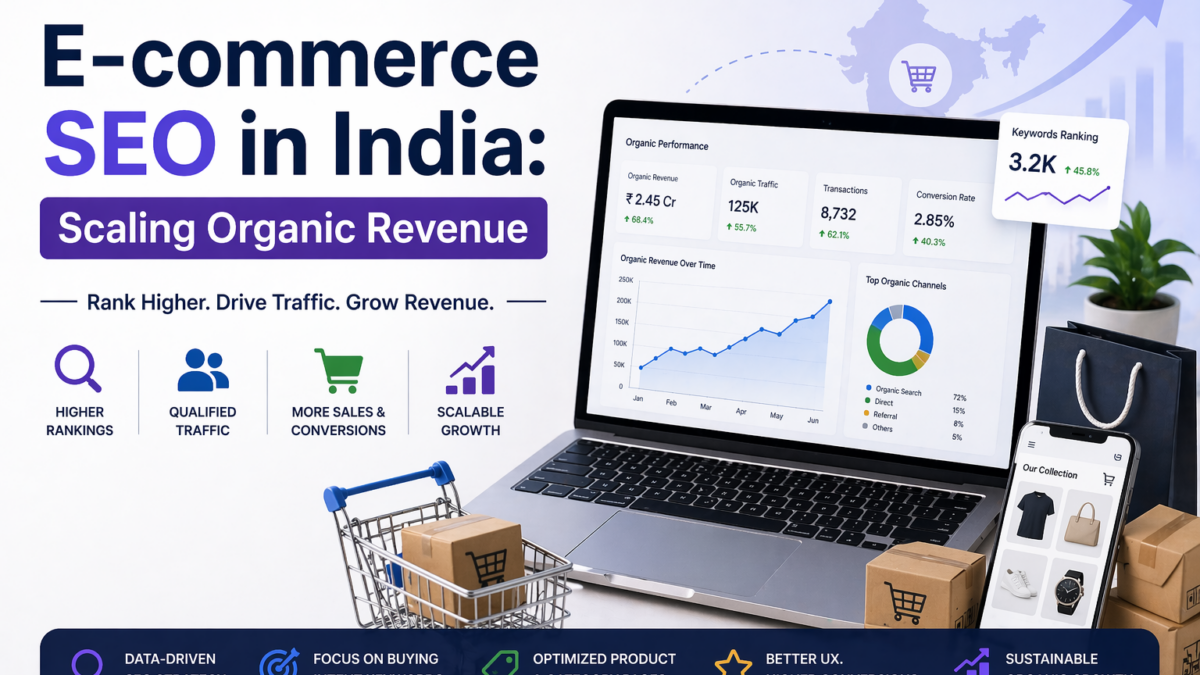
India’s e-commerce landscape has matured rapidly. By 2026, online retail is no longer driven only by discounts, paid ads, or marketplace dependence. Rising ad costs, shrinking margins, and intense competition have pushed Indian e-commerce brands to rethink growth strategies. Organic search has emerged as the most sustainable and scalable revenue channel.
However, e-commerce SEO is fundamentally different from traditional website SEO. It involves thousands of dynamic URLs, constantly changing inventories, and highly transactional search intent. Brands that approach SEO with outdated methods struggle to scale, while those that integrate SEO into their revenue model continue to grow steadily.
This blog explores how e-commerce SEO in India works in 2026, what has changed, and how businesses can scale organic revenue without relying excessively on paid acquisition.
Why E-commerce SEO Matters More Than Ever in India
By 2026, Indian consumers are more research-driven than impulse-driven. Before purchasing, users compare:
- Prices
- Reviews
- Alternatives
- Brand credibility
Organic search captures users at every stage of this journey. Unlike paid ads, SEO builds long-term visibility and trust.
Key reasons e-commerce SEO is critical:
- Paid ads deliver diminishing returns
- Marketplaces limit brand ownership
- Organic traffic compounds over time
This makes SEO a core growth asset, not a supporting channel.
How E-commerce SEO Differs from Traditional SEO
E-commerce SEO operates at scale and complexity.
Major differences include:
- Large product catalogs
- Faceted navigation and filters
- Duplicate content risks
- Constant URL changes
Success depends on precision, structure, and automation—without losing strategic control.
Brands offering SEO services in India increasingly specialize in e-commerce because generic SEO approaches fail at scale.
Category Pages: The Real Revenue Drivers
By 2026, category pages outperform product pages for organic revenue.
Why?
- Users search broadly before narrowing choices
- Category pages match commercial intent
- Search engines prefer consolidated relevance
High-Performing Category Pages Include:
- Descriptive, intent-aligned content
- Clear internal linking
- Logical filtering without crawl waste
- Supporting informational sections
Category pages are no longer simple product listings they are strategic landing pages
Product Page Optimization in 2026
Product pages still matter, but optimization has evolved.
Modern product SEO focuses on:
- Unique product descriptions
- Structured data for rich results
- User-generated content integration
- Fast mobile performance
Duplicate manufacturer descriptions no longer rank consistently. Search engines expect differentiation and clarity.
Content That Drives E-commerce Conversions
Content in e-commerce SEO is not about blogging volume it’s about decision support.
Effective content types include:
- Buying guides
- Comparison pages
- Use-case explanations
- Objection-handling FAQs
This content reduces friction and supports purchase decisions, improving both rankings and conversions.
Brands working with the Best SEO company in India treat content as a conversion tool, not just a traffic driver.
Technical SEO: The Backbone of Scalable Growth
Technical SEO is where most Indian e-commerce websites struggle.
Critical technical priorities in 2026:
- Crawl budget optimization
- Canonical handling for filters
- Clean URL structures
- Core Web Vitals under load
Search engines reward e-commerce sites that are easy to crawl, fast to load, and logically structured.
Without technical discipline, organic growth plateaus quickly.
Managing Filters, Facets, and Indexation
Indian e-commerce sites often suffer from uncontrolled indexation.
Common problems:
- Infinite URL combinations
- Duplicate filtered pages
- Wasted crawl budget
SEO strategy must define:
- Which pages to index
- Which to block
- Which to canonicalize
This level of control separates scalable brands from stagnant ones.
Trust Signals in Indian E-commerce SEO
Trust directly influences rankings and revenue.
Search engines evaluate:
- Brand mentions
- Review authenticity
- Clear business information
- Transparent policies
Users in India are particularly trust-sensitive, especially for higher-value purchases.
A Top SEO agency in India integrates trust-building elements directly into SEO strategy.
Local and Regional SEO for E-commerce
Even national e-commerce brands benefit from regional relevance.
By 2026:
- Location-based delivery searches have increased
- Regional language queries influence discovery
- City-specific availability impacts conversions
Optimizing for regional demand improves both visibility and user satisfaction.
Measuring Organic Revenue, Not Just Traffic
Traffic without revenue is misleading.
Effective e-commerce SEO measurement includes:
- Revenue per organic session
- Assisted conversions
- Category-level performance
- Search intent segmentation
SEO teams must work closely with analytics and conversion data to refine strategy.
Common E-commerce SEO Mistakes in India
Many brands still struggle due to:
- Treating SEO as content publishing
- Ignoring technical limitations
- Over-prioritizing product pages
- Measuring success only by rankings
These mistakes limit scalability and ROI.
The Long-Term Advantage of SEO-Led Growth
When SEO is embedded into e-commerce strategy:
- Customer acquisition costs decline
- Brand trust strengthens
- Revenue becomes more predictable
Organic search becomes a growth engine, not a marketing expense.
Conclusion
E-commerce SEO in India in 2026 is no longer optional it is foundational. Brands that invest in structured SEO strategies, technical excellence, and user-focused content scale organic revenue sustainably, even in competitive markets.
SEO is not about chasing algorithms. It’s about aligning with how Indian consumers search, evaluate, and buy online.
FAQs
1. Is SEO still effective for Indian e-commerce brands in 2026?
Yes. SEO is one of the most cost-effective and scalable growth channels for e-commerce.
2. How long does e-commerce SEO take to show revenue impact?
Initial traction appears in 3–6 months, with compounding growth over time.
3. Are product pages or category pages more important?
Category pages usually drive higher organic revenue due to broader intent.
4. Can small e-commerce stores compete with large platforms?
Yes. Niche focus and strong SEO fundamentals often outperform scale alone.
5. What is the biggest SEO challenge for Indian e-commerce sites?
Technical scalability and indexation control.
Leave a Reply