
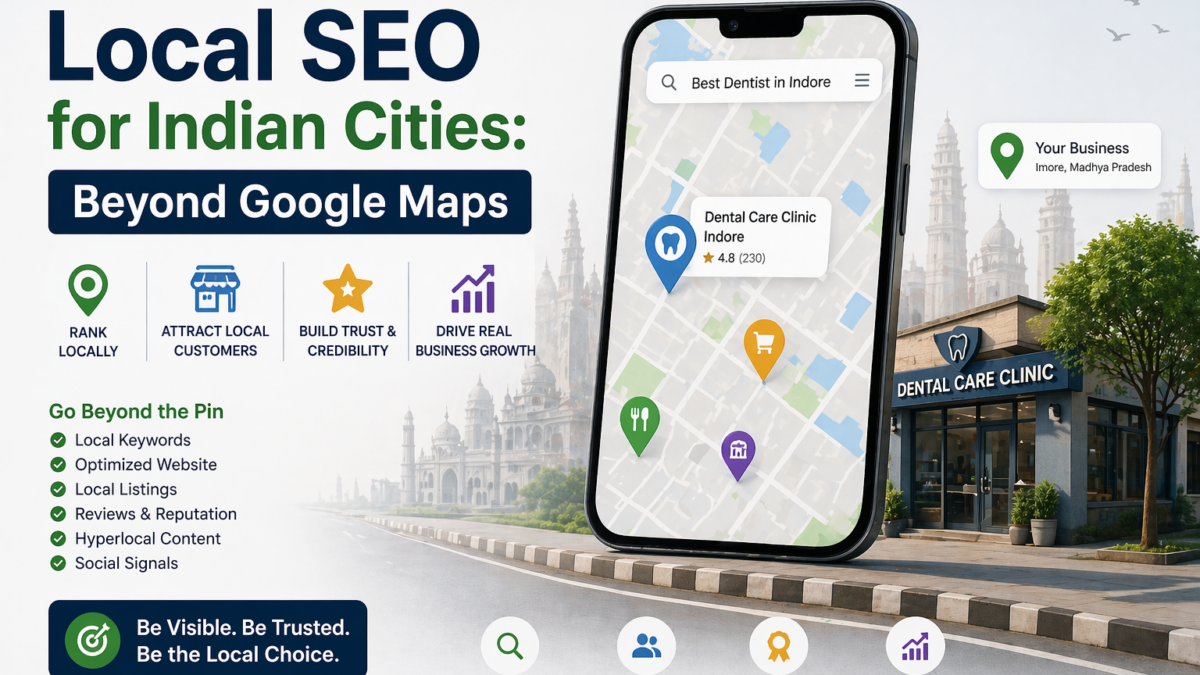
Local SEO in India has undergone a fundamental transformation. For years, businesses believed that local visibility began and ended with Google Maps optimize a listing, collect reviews, and wait for customers to arrive. While that approach once worked, it is no longer sufficient in 2026.
Indian search behavior has evolved. Users now search with intent that goes far beyond proximity. They compare services, evaluate trust, read local insights, and expect businesses to demonstrate relevance to their specific city or region. Search engines, in turn, evaluate local authority holistically not just through listings, but through content depth, engagement, and real-world credibility.
This blog explores how local SEO in Indian cities has moved beyond maps and how businesses can build sustainable local visibility in 2026.
How Local Search Behavior Has Changed in India
India’s urban digital adoption has accelerated dramatically. Tier-1, Tier-2, and even Tier-3 cities now show advanced search behavior.
By 2026, local searches commonly include:
- City-specific comparisons
- Service + locality intent
- Trust and review validation
- Language-specific phrasing
Users are no longer just asking “Who is nearby?” They are asking “Who is reliable, relevant, and proven in my city?”
Search engines reflect this shift by ranking businesses that demonstrate local experience, not just local presence.
Why Google Maps Alone Is Not Enough
Maps listings remain important but they are only one signal among many.
Limitations of Map-Only Optimization
Relying solely on listings creates vulnerabilities:
- High competition in dense cities
- Limited visibility for informational searches
- Dependency on reviews alone
- Weak differentiation
Search engines increasingly cross-reference listings with website content, brand mentions, and user engagement signals.
Local SEO success now requires ecosystem thinking, not single-platform optimization.
Local Authority: The New Ranking Currency
Local authority refers to how strongly a business is associated with a specific city or region across the web.
Search engines measure:
- City-specific content relevance
- Local backlinks and citations
- Mentions in regional platforms
- User engagement from local visitors
Businesses offering SEO services in India now build local authority models rather than focusing only on listing optimization.
Building City-Specific Content That Ranks
Generic “We serve all cities” pages no longer perform well.
What Works in 2026
High-performing local content includes:
- City-specific service pages
- Local case studies and examples
- Area-based problem-solution narratives
- Region-aware language and tone
Each city page must feel like it was written for that city, not duplicated across locations.
Hyper-Local Intent and Micro-Markets
Indian cities contain micro-markets neighborhoods, commercial zones, and cultural clusters.
Search engines increasingly recognize:
- Area-level relevance
- Neighborhood intent
- Hyper-local behavior patterns
Businesses that structure content around micro-locations gain higher visibility and stronger conversion rates.
This approach is now standard practice for brands working with the Best SEO company in India, especially in competitive urban markets.
Reviews as Trust Infrastructure
In 2026, reviews influence far more than map rankings.
Search engines evaluate:
- Review consistency over time
- Language relevance
- Response behavior
- Cross-platform sentiment
Reviews act as behavioral validation signals, reinforcing trust and credibility beyond listings.
Quality, authenticity, and engagement matter more than volume.
The Role of Local Backlinks and Mentions
Local links are no longer about directories alone.
High-value local authority signals come from:
- Regional news mentions
- Local business partnerships
- Community platforms
- Industry-specific city portals
These mentions strengthen geographic association and trust.
A Top SEO agency in India focuses on earning regional authority rather than mass-producing citations.
Mobile Experience and Local SEO
Most local searches in India occur on mobile devices.
Local SEO success now depends on:
- Fast mobile load times
- Click-to-call usability
- Location clarity
- Easy navigation
A poor mobile experience undermines even the strongest local authority signals.
Language and Cultural Relevance in Indian Cities
India’s linguistic diversity directly impacts local search.
Successful local SEO strategies:
- Adapt tone to regional expectations
- Respect cultural nuances
- Address city-specific behavior
Search engines reward content that resonates naturally with local users.
Measuring Local SEO Success in 2026
Traditional metrics like rankings are no longer enough.
Effective measurement includes:
- Local engagement metrics
- Conversion intent tracking
- City-level traffic behavior
- Assisted conversions
Local SEO should drive business outcomes, not just impressions.
Common Local SEO Mistakes Indian Businesses Make
Despite evolution, many businesses still:
- Duplicate city pages
- Ignore local content depth
- Rely only on listings
- Neglect mobile UX
These mistakes limit long-term visibility.
Conclusion
Local SEO in Indian cities has moved far beyond maps. By 2026, success depends on relevance, authority, and experience not just proximity. Businesses that invest in city-specific content, local trust signals, and user-focused experiences build durable local visibility.
Local SEO is no longer about being found it’s about being chosen.
FAQs
1. Is Google Maps still important for local SEO?
Yes, but it is only one part of a broader local authority ecosystem.
2. How many city pages should a business create?
Only for cities where real relevance, services, or customers exist quality matters more than quantity.
3. Do reviews affect website rankings?
Indirectly yes. Reviews influence trust, engagement, and conversion behavior.
4. Can small businesses compete in local SEO?
Yes. Local relevance and authenticity often outperform large brands in city-level searches.
5. What is the biggest local SEO trend in 2026?
Building city-specific authority through content, trust signals, and engagement.
Leave a Reply