
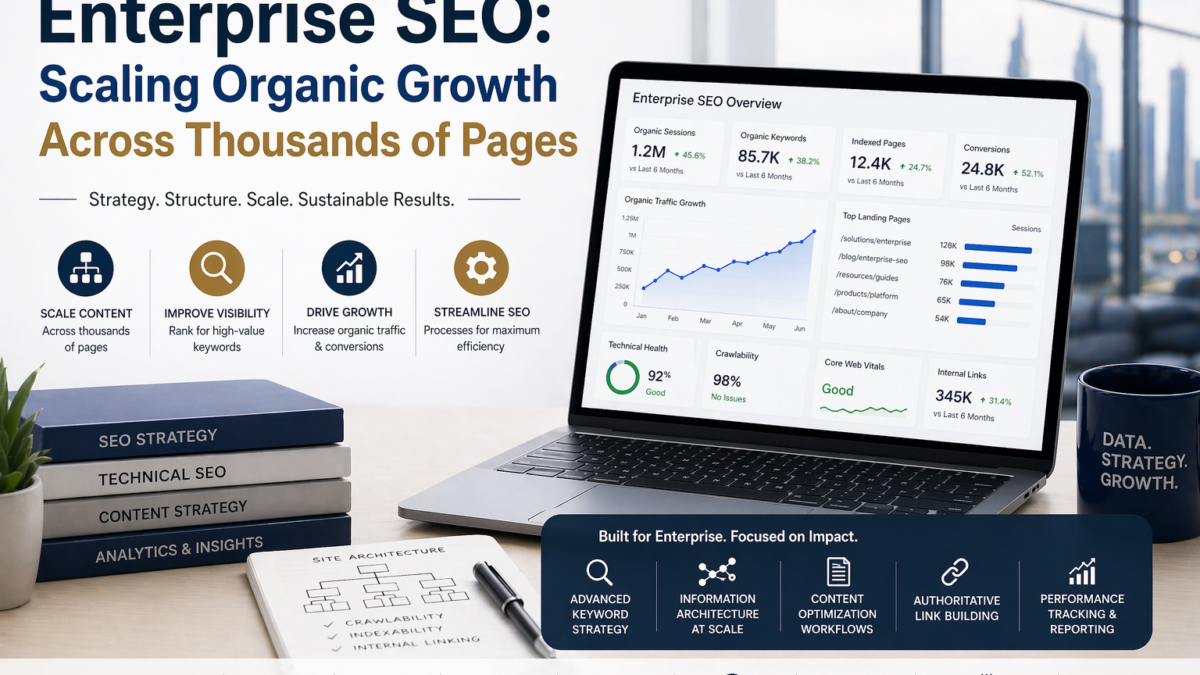
Enterprise SEO operates at a scale where traditional optimization tactics break down. Websites with thousands or even millions of pages face challenges that smaller sites never encounter: crawl inefficiencies, index bloat, technical debt, fragmented content ownership, and misaligned business priorities.
By 2026, search engines have become far more selective about which pages they crawl, index, and rank. For enterprise organizations, SEO is no longer about optimizing individual pages it’s about building systems that scale organic growth sustainably across massive site architectures.
This blog explores how enterprise SEO works today, why many large organizations struggle to scale organic visibility, and how strategy-first execution enables consistent growth across thousands of pages.
Why Enterprise SEO Is Fundamentally Different
Enterprise websites differ from smaller sites in three major ways:
- Scale – Thousands of URLs are created dynamically
- Complexity – Multiple teams manage content, design, and development
- Risk – Small technical changes can impact millions of visits
At this level, SEO errors compound quickly. A minor crawl inefficiency or indexing mistake can suppress entire sections of a website.
This is why enterprise SEO must be proactive, systemized, and aligned with business infrastructure not treated as a marketing add-on.
The Illusion of “More Pages = More Traffic”
Many enterprises assume that publishing more pages automatically increases organic traffic. In reality, by 2026, search engines actively penalize scale without quality.
Common enterprise-scale problems include:
- Thin or duplicated pages
- Auto-generated content with no differentiation
- Overlapping keyword intent across sections
- Index bloat
Instead of helping rankings, uncontrolled growth often reduces overall site authority.
Organizations investing in Professional SEO services at the enterprise level focus on page value, not page volume.
Enterprise SEO Requires a System, Not Tactics
At scale, SEO success depends on frameworks.
Core enterprise SEO systems include:
- URL governance models
- Content lifecycle management
- Technical SEO automation
- Intent-based page classification
- Continuous monitoring and alerts
Without systems, teams react to problems instead of preventing them.
This is where enterprises typically seek the Best SEO company not for execution alone, but for architecture-level strategy.
Content Scaling Without Authority Dilution
Enterprise sites often suffer from internal competition.
Typical issues:
- Multiple pages targeting the same intent
- Department-driven content silos
- Inconsistent messaging across sections
Search engines struggle to identify which page represents authority.
Effective enterprise SEO solves this through:
- Topic consolidation
- Canonical content hubs
- Clear internal linking hierarchies
- Content pruning
Scaling content responsibly is more powerful than publishing endlessly.
Technical SEO as an Enterprise Growth Lever
At scale, technical SEO directly influences revenue.
Critical enterprise technical factors include:
- Crawl budget efficiency
- JavaScript rendering control
- Pagination and faceted navigation handling
- Core Web Vitals at scale
Enterprise SEO teams must work closely with engineering not after releases, but during planning.
Aligning SEO With Business Units
Enterprise SEO often fails due to misalignment.
SEO teams may not control:
- Product roadmaps
- CMS rules
- Deployment schedules
To scale organic growth, SEO must be embedded into:
- Development workflows
- Content governance
- Product decision-making
This is why a Top SEO agency at the enterprise level functions as a strategic partner, not a vendor.
Automation Without Losing Strategic Control
Automation is essential at scale but dangerous without oversight.
Effective automation supports:
- Template-level optimization
- Scalable internal linking
- Structured data deployment
- Monitoring and alerting
Poor automation creates:
- Duplicate metadata
- Index bloat
- Rendering issues
Strategy determines what should be automated and what should not.
Measuring Enterprise SEO Success Correctly
Enterprise SEO cannot be measured by rankings alone.
Meaningful metrics include:
- Indexation efficiency
- Crawl waste reduction
- Organic revenue contribution
- Page group performance
- Content ROI by intent
Measurement must reflect business impact, not just visibility.
Common Enterprise SEO Mistakes
Even large organizations repeatedly:
- Prioritize quantity over quality
- Ignore crawl and indexation limits
- Treat SEO as a marketing-only function
- React late to technical issues
At scale, these mistakes are costly and slow to reverse.
Long-Term Value of Enterprise SEO
When executed correctly, enterprise SEO delivers:
- Predictable organic growth
- Lower acquisition costs
- Stronger brand authority
- Reduced dependency on paid channels
SEO becomes infrastructure not a campaign.
Conclusion
Enterprise SEO in 2026 is about control, clarity, and coordination. Scaling organic growth across thousands of pages requires systems, not shortcuts. Search engines reward enterprises that demonstrate intent alignment, technical excellence, and content discipline at scale.
Organizations that invest in strategy-first enterprise SEO build durable visibility that compounds year after year.
FAQs
1. Is enterprise SEO harder than regular SEO?
Yes. Scale, complexity, and risk make enterprise SEO significantly more challenging.
2. How long does enterprise SEO take to show results?
Typically 6–9 months for structural improvements, with long-term compounding benefits.
3. Can enterprise SEO be automated fully?
No. Automation supports execution, but strategy must remain human-led.
4. What is the biggest risk in enterprise SEO?
Index bloat and crawl inefficiency.
5. Why do large websites lose rankings suddenly?
Small technical changes can impact thousands of pages simultaneously.
Leave a Reply