
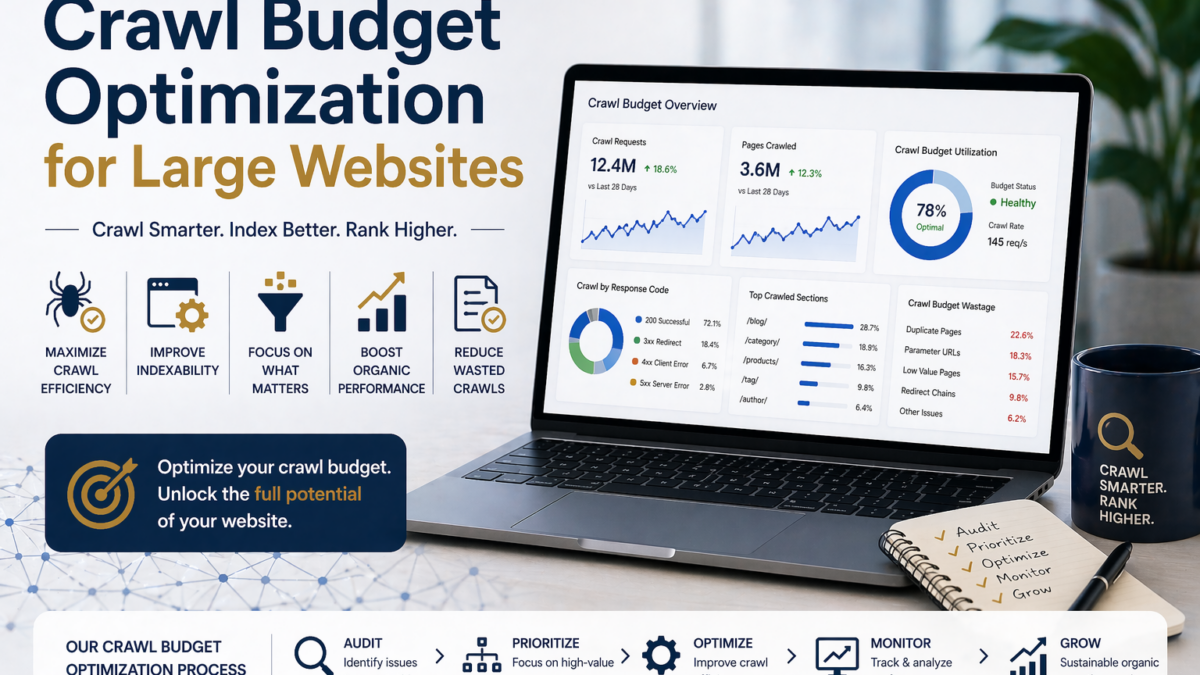
For large websites, visibility in search engines is not limited by content quality alone—it is constrained by crawl efficiency. No matter how authoritative a domain may be, search engines allocate a finite amount of crawl resources. When that crawl budget is wasted, even high-value pages can remain undiscovered, outdated, or poorly ranked.
By 2026, crawl budget optimization has become one of the most critical technical SEO disciplines for enterprise-scale websites. As sites grow into tens or hundreds of thousands of URLs, inefficient crawling directly limits organic performance.
This blog explains what crawl budget really means today, why large websites struggle with it, and how to optimize crawling to unlock scalable organic growth.
What Crawl Budget Actually Means in 2026
Crawl budget is often misunderstood as a fixed quota. In reality, it is a dynamic balance between:
- Crawl capacity (how much a site can handle)
- Crawl demand (how valuable search engines believe pages are)
Search engines prioritize crawling pages that are:
- Frequently updated
- Strongly linked internally
- Proven to deliver value to users
Large websites that fail to signal value at scale often see critical pages crawled less frequently or not at all.
Why Large Websites Waste Crawl Budget
Crawl inefficiency rarely comes from one issue. It’s usually the result of multiple compounding problems.
Common crawl budget drains include:
- Duplicate URLs created by filters and parameters
- Infinite pagination and faceted navigation
- Thin or expired content still indexable
- Poor internal linking distribution
- Broken or redirected URLs at scale
Over time, these issues dilute crawl focus and reduce search engine trust.
Organizations investing in Professional SEO services often discover that crawl waste not content quality is the true growth blocker.
Crawl Budget vs Indexation: Not the Same Problem
A critical mistake large websites make is confusing crawling with indexation.
Key differences:
- Crawling = discovery and refresh
- Indexation = eligibility for ranking
A page can be crawled but not indexed.
A page can be indexed but rarely crawled.
A page can exist without either happening efficiently.
Solving crawl budget issues requires understanding how search engines allocate attention—not just whether pages appear in the index.
How Crawl Budget Impacts Rankings Indirectly
Crawl budget does not rank pages but it determines which pages get the chance to rank.
Poor crawl efficiency leads to:
- Slow content updates being recognized
- Delayed technical fixes being reflected
- Important pages becoming “stale”
- Algorithmic trust erosion
This is why enterprises working with the Best SEO company prioritize crawl optimization before chasing new keyword opportunities.
Identifying Crawl Budget Waste
Diagnosis always comes before optimization.
Key signals of crawl waste include:
- High crawl volume on low-value URLs
- Important pages crawled infrequently
- Index bloat without traffic contribution
- Excessive parameter-based URLs
Log file analysis is essential at this stage. Without it, crawl optimization becomes guesswork.
URL Control at Scale
URL governance is the foundation of crawl efficiency.
Large websites must actively control:
- Which parameters generate crawlable URLs
- How pagination is handled
- Whether filters are indexable
- Canonical consistency
Every unnecessary URL competes with important pages for crawl attention.
Internal Linking as a Crawl Signal
Internal links are not just for users they are crawl directives.
Search engines interpret internal linking as:
- Priority signals
- Relationship indicators
- Discovery pathways
Enterprise sites often suffer from:
- Deep orphaned pages
- Uneven link distribution
- Navigation-driven crawl traps
Optimizing internal linking redistributes crawl equity toward high-value pages.
Managing JavaScript and Rendering Costs
Modern websites rely heavily on JavaScript, but rendering is expensive for crawlers.
Large JS-heavy sites risk:
- Delayed content discovery
- Partial rendering
- Reduced crawl frequency
SEO for modern frameworks requires:
- Server-side rendering where possible
- Hybrid rendering strategies
- Clear content availability without user interaction
Crawl budget must account for rendering cost, not just URL count.
Pruning for Crawl Efficiency
More pages does not mean more value.
Content pruning improves crawl efficiency by:
- Removing expired or low-performing pages
- Consolidating overlapping content
- Deindexing utility or thin URLs
Pruning sends a strong signal: this site values quality over volume.
XML Sitemaps Are Not a Crawl Fix
Sitemaps help but they don’t solve crawl waste.
Sitemaps should:
- Contain only index-worthy URLs
- Be segmented logically
- Reflect priority accurately
Submitting bloated sitemaps can actually dilute crawl focus.
How Crawl Budget Optimization Scales Growth
When crawl budget is optimized:
- Important pages are refreshed more frequently
- New content is discovered faster
- Technical fixes propagate quicker
- Ranking stability improves
This creates compounding organic performance over time.
A Top SEO agency treats crawl optimization as ongoing infrastructure, not a one-time technical task.
Measuring Crawl Budget Success
Crawl optimization success is measured by:
- Increased crawl frequency on priority pages
- Reduced crawl activity on low-value URLs
- Improved indexation efficiency
- Faster recognition of content updates
Rankings improve as a downstream effect.
Common Crawl Budget Mistakes
Large websites often:
- Block pages blindly with robots.txt
- Ignore parameter explosion
- Let CMS auto-generate crawlable URLs
- Focus on sitemaps instead of architecture
These mistakes waste months of potential growth.
Long-Term Value of Crawl Optimization
Crawl budget optimization:
- Protects large sites from algorithmic volatility
- Improves SEO scalability
- Reduces technical debt
- Increases ROI from existing content
It is one of the highest-leverage SEO investments for enterprise websites.
Conclusion
For large websites, crawl budget is the gatekeeper of organic visibility. Without efficient crawling, even the best content and strongest authority fail to perform at scale. By optimizing URL control, internal linking, rendering strategy, and index discipline, enterprises unlock sustainable organic growth.
Crawl budget optimization is not optional it is foundational.
FAQs
1. Do small websites need crawl budget optimization?
Usually no. Crawl budget issues primarily affect large and complex sites.
2. How do I know if my site has crawl budget problems?
Log files, crawl stats, and index inefficiencies are key indicators.
3. Does blocking URLs always help crawl budget?
No. Blocking the wrong URLs can hide valuable content from search engines.
4. How often should crawl optimization be reviewed?
Continuously especially after site changes or content expansion.
5. Is crawl budget optimization a one-time task?
No. It’s an ongoing process tied to site growth.
Leave a Reply