
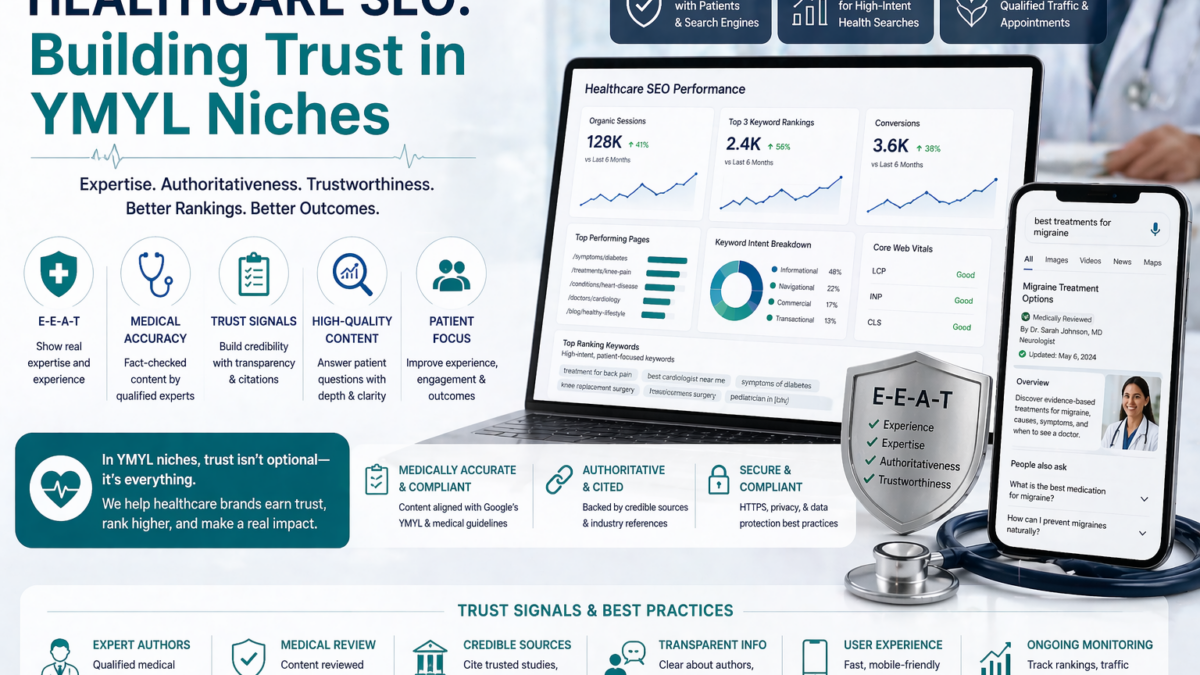
Healthcare SEO is unlike any other vertical. In 2026, search engines treat health-related content as high-risk, high-responsibility information. A single misleading page can cause real-world harm, which is why healthcare websites fall under the strict YMYL (Your Money or Your Life) category.
Ranking in healthcare search is no longer about publishing more content or chasing medical keywords. It’s about trust, accuracy, expertise, and credibility at scale. Clinics, hospitals, health startups, and medical platforms that fail to understand this reality often see volatile rankings, suppressed visibility, or complete exclusion from competitive search results.
This blog explores how healthcare SEO works in 2026, why trust is the core ranking factor in YMYL niches, and how healthcare brands can build sustainable organic visibility without risking credibility.
What Makes Healthcare SEO Different
Search engines apply stricter evaluation frameworks to healthcare content than almost any other industry.
Healthcare SEO is governed by:
- Higher quality thresholds
- Stronger credibility requirements
- Expert authorship validation
- Risk-based ranking suppression
Unlike retail or SaaS, “good enough” content does not survive long in healthcare search.
Understanding YMYL and Its Impact
YMYL content influences decisions related to:
- Health
- Safety
- Financial stability
- Life outcomes
Because of this, search engines:
- Scrutinize sources
- Penalize uncertainty
- Suppress unverified claims
- Reward institutional trust
Healthcare SEO success begins with accepting that authority must be demonstrated, not implied.
Why Healthcare Websites Fail at SEO
Most healthcare SEO failures are not technical they are strategic.
Common causes include:
- Generic content written without medical oversight
- No clear author credentials
- Over-optimized pages with weak substance
- Mismatch between intent and content depth
Healthcare SEO is not forgiving. Weak signals are amplified rather than ignored.
This is why organizations investing in Professional SEO services often start by rebuilding trust frameworks before touching keywords.
Expertise Is the Foundation of Visibility
In healthcare SEO, who creates content matters as much as what it says.
Strong expertise signals include:
- Verified medical professionals
- Clear author bios
- Institutional affiliations
- Transparent editorial review processes
Search engines actively evaluate whether content reflects real-world medical expertise.
Author Authority and Content Accountability
Anonymous healthcare content struggles to rank in 2026.
Best practices include:
- Named medical reviewers
- Credential disclosure
- Review dates and update history
- Clear disclaimers
Healthcare content must look accountable because it is.
Search Intent in Healthcare Queries
Healthcare searches are deeply intent-driven.
Common intent types include:
- Symptom research
- Condition understanding
- Treatment comparison
- Provider selection
Pages that mix intents confuse users and lose rankings. Precision matters more than volume.
Content Depth Over Content Volume
Publishing hundreds of thin medical articles is a losing strategy.
Search engines reward:
- Comprehensive condition coverage
- Evidence-backed explanations
- Risk and limitation disclosures
- Balanced, non-sensational tone
This approach aligns with how the structures healthcare content strategies fewer pages, stronger trust signals.
Local SEO and Healthcare Trust
Healthcare decisions are often local and high-stakes.
Local SEO factors include:
- Accurate provider information
- Consistent clinic data
- Verified reviews
- Location-specific expertise
Local trust signals directly influence both rankings and conversions.
Reviews, Reputation, and Off-Page Trust
In healthcare, reputation is a ranking signal.
Search engines evaluate:
- Review sentiment
- Brand mentions
- External citations
- Media coverage
Negative reputation signals can suppress visibility even if on-page SEO is strong.
Technical SEO Still Matters – But Differently
Healthcare sites must meet high technical standards.
Critical elements include:
- Secure infrastructure (HTTPS)
- Fast, stable performance
- Clean site architecture
- Accessibility compliance
Technical excellence supports trust it doesn’t replace it.
Structured Data for Medical Content
Proper structured data helps search engines:
- Understand medical entities
- Connect symptoms to conditions
- Validate provider information
Incorrect or misleading markup can hurt credibility instead of helping.
Content Updates Are Mandatory in Healthcare
Medical information evolves constantly.
Outdated content is risky and ranking-suppressive.
Healthcare SEO requires:
- Regular reviews
- Timestamped updates
- Evidence refresh cycles
Stale content erodes both trust and rankings.
Balancing Compliance and SEO
Healthcare websites must align SEO with:
- Regulatory standards
- Ethical communication
- Patient safety
Aggressive optimization tactics often conflict with compliance and search engines side with safety.
This balance is where a Top SEO agency provides strategic value, not shortcuts.
Measuring Success in Healthcare SEO
Healthcare SEO success is not just traffic.
Meaningful metrics include:
- Visibility stability
- High-intent engagement
- Qualified leads
- Trust indicators
Volatile rankings often signal weak credibility foundations.
Long-Term Value of Trust-Based SEO
Trust-driven healthcare SEO:
- Compounds over time
- Reduces algorithm risk
- Strengthens brand authority
- Improves patient confidence
Short-term tactics rarely survive YMYL scrutiny.
Conclusion
Healthcare SEO in 2026 is fundamentally about trust. In YMYL niches, search engines act as gatekeepers, prioritizing safety, credibility, and expertise over aggressive optimization. Brands that treat SEO as a content volume game struggle, while those that invest in authority, accuracy, and accountability build lasting visibility.
Success in healthcare search is earned slowly but once earned, it is resilient.
FAQs
1. Why is healthcare SEO harder than other industries?
Because it falls under YMYL, requiring higher trust and expertise standards.
2. Can AI-written healthcare content rank?
Only with strong human oversight, medical review, and accountability.
3. How long does healthcare SEO take to show results?
Typically longer than other niches often 6–9 months.
4. Are backlinks important for healthcare SEO?
Yes, but relevance and authority matter more than quantity.
5. What is the biggest ranking factor in healthcare SEO?
Trust demonstrated through expertise, accuracy, and reputation.
Leave a Reply