
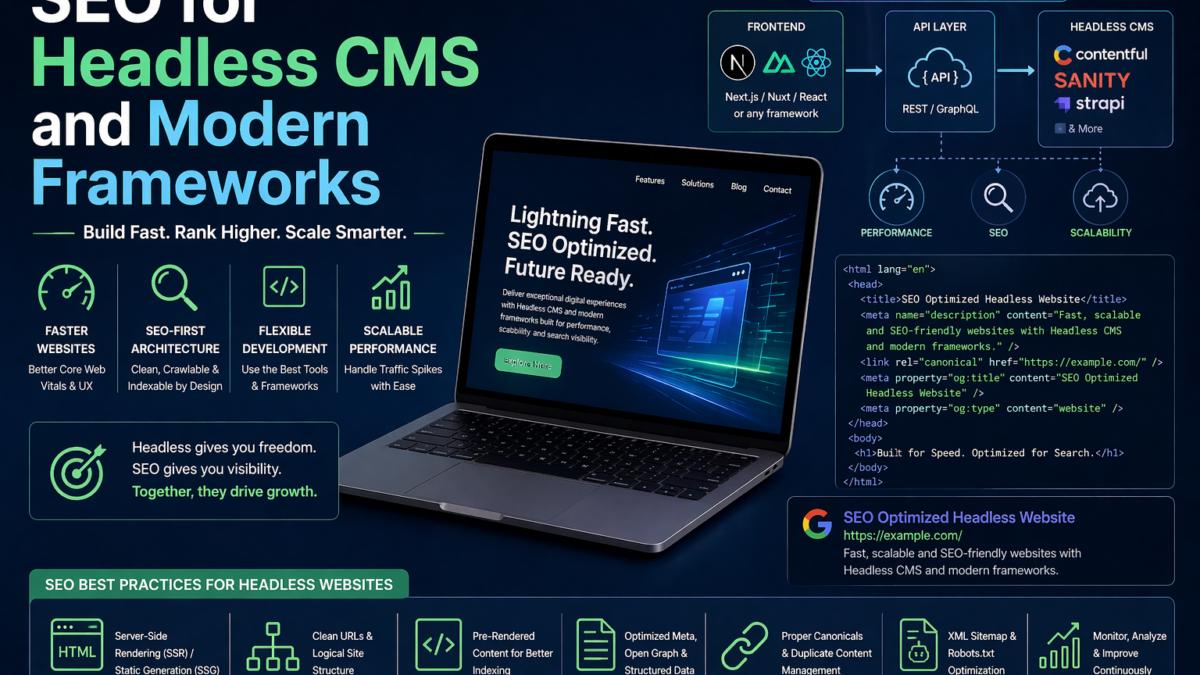
The way websites are built has changed dramatically. Traditional monolithic CMS platforms are rapidly being replaced by headless CMS architectures and modern JavaScript frameworks such as React, Vue, and server-driven frontend stacks. These technologies offer speed, flexibility, and scalability but they also introduce new SEO complexities that many teams underestimate.
In 2026, SEO for headless and modern frameworks is no longer experimental. It is mission-critical for enterprises, SaaS platforms, publishers, and high-growth brands. When implemented correctly, headless architecture can outperform traditional setups. When implemented poorly, it can silently destroy organic visibility.
This blog explains how SEO works in a headless environment, where most implementations fail, and how to build a framework that scales organic growth without sacrificing performance.
What Is a Headless CMS?
A headless CMS separates:
- Content management (backend)
- Content presentation (frontend)
Content is delivered via APIs instead of server-rendered templates. This allows teams to use modern frameworks while managing content centrally.
From a business standpoint, headless CMS enables:
- Faster development cycles
- Multi-platform publishing
- Better performance control
From an SEO standpoint, it changes how search engines discover, render, and evaluate content.
Why SEO Breaks in Headless Implementations
Most SEO failures in headless environments are not caused by search engines—they’re caused by assumptions.
Common mistakes include:
- Relying entirely on client-side rendering
- Treating SEO as a frontend afterthought
- Ignoring crawl and rendering costs
- Mismanaging URLs and internal linking
SEO does not “automatically work” just because a framework is fast.
Rendering Strategy Is the SEO Foundation
Rendering determines whether search engines can reliably access content.
There are three primary approaches:
- Client-Side Rendering (CSR)
- Server-Side Rendering (SSR)
- Static Site Generation (SSG)
Pure CSR is risky at scale. While search engines can render JavaScript, it introduces delays, crawl inefficiencies, and indexing unpredictability.
This is why teams using Professional SEO services often revisit rendering decisions early in headless migrations.
Why Server-Side Rendering Still Matters
SSR delivers fully rendered HTML to crawlers and users alike.
Benefits include:
- Faster content discovery
- Reduced crawl dependency on rendering
- More consistent indexing
For large or frequently updated websites, SSR provides stability that pure client-side approaches struggle to match.
JavaScript SEO in 2026: What Changed
Search engines have improved JavaScript handling but limits still exist.
Challenges include:
- Deferred content loading
- API failures during rendering
- Inconsistent hydration
- Resource-heavy pages reducing crawl frequency
SEO-friendly JavaScript is not about avoiding JS it’s about controlling how and when content is exposed.
URL Architecture in Headless Systems
Modern frameworks often generate URLs dynamically.
Common issues:
- Duplicate URLs from routing logic
- Parameter-based rendering
- Inconsistent trailing slashes
- Canonical confusion
Search engines need a clean, predictable URL structure to understand site hierarchy and page relationships.
Metadata Is No Longer Automatic
In traditional CMS platforms, meta tags are often handled natively.
In headless setups:
- Titles
- Meta descriptions
- Canonicals
- Open Graph tags
must be explicitly managed and dynamically injected. Missing or delayed metadata is a frequent cause of ranking loss after headless migrations.
Internal Linking in Component-Based Frontends
Internal linking is often overlooked in component-driven design systems.
Problems include:
- Links generated only after user interaction
- Navigation built entirely in JavaScript
- Orphaned pages lacking crawl paths
Search engines rely on static, discoverable links not just runtime navigation.
This is one reason why the Best SEO company evaluates component architecture alongside content strategy.
Content Parity Between Users and Crawlers
A critical SEO rule still applies:
Search engines must see the same content users see.
Violations happen when:
- Content loads after scroll
- APIs fail for crawlers
- Conditional rendering hides sections
Even unintentional discrepancies can suppress rankings.
Headless CMS and Crawl Budget
Headless architectures often scale content rapidly.
Without control, this leads to:
- Crawl budget dilution
- Index bloat
- Discovery delays for priority pages
Efficient headless SEO requires:
- URL governance
- Index discipline
- Content pruning strategies
SEO scalability is architectural, not just editorial.
Structured Data in Headless Environments
Structured data must be:
- Rendered server-side
- Consistent with visible content
- Maintained across templates
Improper implementation can invalidate otherwise strong content.
Performance: More Than Just Page Speed
Headless sites are often fast but performance metrics go beyond load time.
SEO-relevant performance factors include:
- Time to first byte
- Render stability
- Interaction readiness
- Resource prioritization
Search engines evaluate experience, not framework popularity.
SEO Testing Before and After Deployment
One of the biggest headless SEO mistakes is launching without baseline testing.
Essential checks include:
- Crawl simulations
- Rendered HTML comparisons
- Indexation verification
- Log file analysis
SEO migrations fail not because of headless tech but because of rushed execution.
When Headless SEO Goes Wrong
Symptoms of poor implementation include:
- Sudden index loss
- Ranking volatility
- Pages indexed without traffic
- Slow recovery after updates
These issues often take months to diagnose if not planned for.
This is where a Top SEO agency brings value not by “fixing SEO later,” but by embedding SEO into the build process.
Long-Term SEO Benefits of Headless (Done Right)
When implemented correctly, headless CMS can:
- Improve crawl efficiency
- Accelerate content deployment
- Enable scalable SEO architectures
- Support multi-market expansion
SEO success is not about choosing modern tools it’s about using them intelligently.
Future-Proofing SEO in Modern Frameworks
SEO-friendly headless systems prioritize:
- Predictable rendering
- Clean URL structures
- Stable metadata delivery
- Crawl-aware content expansion
Frameworks will evolve. SEO fundamentals will not.
Conclusion
SEO for headless CMS and modern frameworks is no longer optional it’s foundational. In 2026, search engines reward sites that combine performance, clarity, and value, regardless of how they’re built.
Headless architecture can be a competitive advantage or a silent liability. The difference lies in strategy, execution, and long-term thinking. When SEO is embedded into the framework not layered on top organic growth becomes scalable, resilient, and sustainable.
FAQs
1. Is headless CMS bad for SEO?
No. Poor implementation is bad for SEO not the architecture itself.
2. Is client-side rendering enough for SEO?
It can work for small sites, but it’s risky at scale.
3. Do search engines fully understand JavaScript now?
They understand more than before, but rendering limits still exist.
4. Should SEO be involved before headless migration?
Yes. SEO should guide architecture decisions, not react to them.
5. Can headless CMS outperform traditional CMS in SEO?
Yes—when rendering, crawl control, and content strategy are handled correctly.
Leave a Reply