One of the most common reasons SEO fails to deliver revenue is not poor execution—it’s poor alignment. Many websites target keywords without understanding who is searching, why they are searching, and what decision they are trying to make. As a result, content ranks but does not influence outcomes.
In 2026, successful SEO strategies begin with a clear understanding of the buyer journey. Keywords are no longer just search terms; they are signals of intent, awareness, and readiness. Mapping SEO keywords to the buyer journey is how rankings turn into real business growth.
Why Keyword Mapping Matters More Than Ever
Search engines have become exceptionally good at identifying intent. They evaluate whether content satisfies the user’s underlying need—not just whether it includes matching words.
When keywords are misaligned with the buyer journey:
- Visitors feel confused or disappointed
- Engagement drops
- Conversions fail
- Rankings eventually decline
Keyword mapping prevents these breakdowns by aligning content with buyer expectations.
The Buyer Journey: A Strategic Overview
While journeys vary by industry, most follow a consistent pattern:
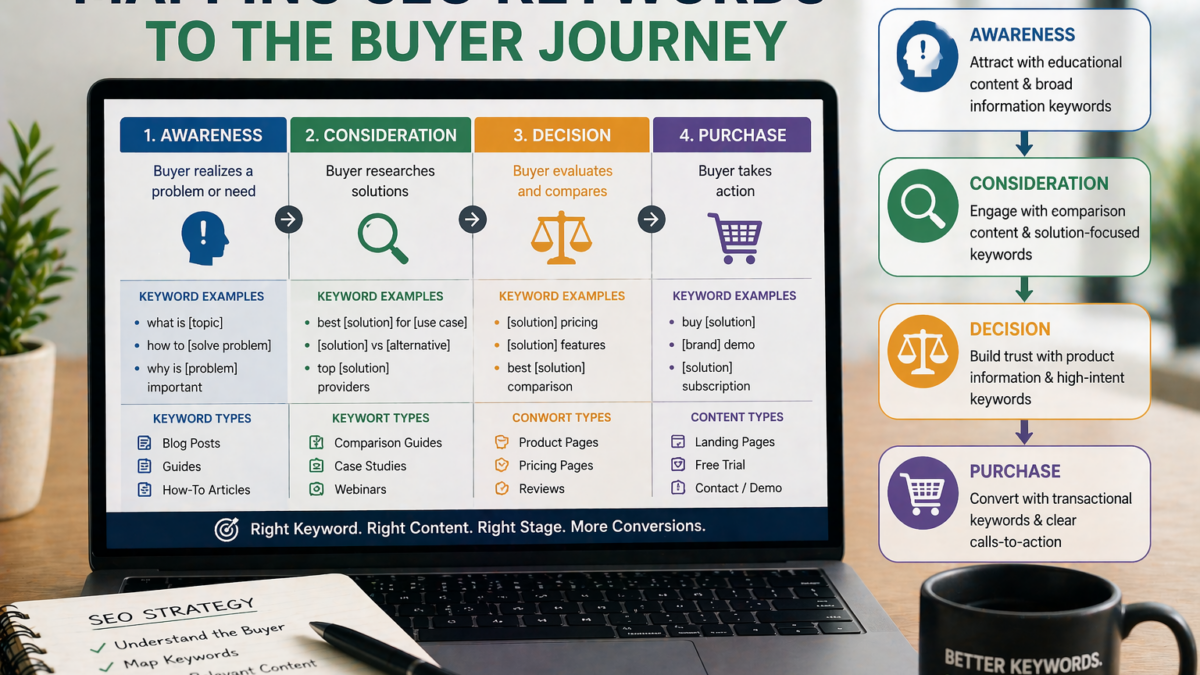
- Awareness – recognizing a problem or opportunity
- Consideration – exploring options and approaches
- Decision – choosing a solution or provider
SEO must support each stage differently. Treating all keywords the same ignores how buyers think and decide.
Awareness Stage: Problem Discovery Keywords
At the awareness stage, buyers are not looking for vendors.
They search for:
- Symptoms
- Causes
- Explanations
- Risks
Examples include “why does,” “how to fix,” or “what causes.” These keywords build visibility and trust but rarely convert immediately.
The Role of Awareness Content
Awareness content:
- Educates without selling
- Frames the problem clearly
- Builds credibility early
This is where SEO supports demand creation rather than lead capture.
Consideration Stage: Solution Exploration Keywords
In the consideration stage, buyers begin evaluating options.
Keyword patterns shift toward:
- “Best way to”
- “Tools for”
- “Solutions vs alternatives”
This is where SEO begins influencing preferences and positioning specific approaches as superior.
Consideration Content That Performs
Effective mid-funnel content:
- Compares approaches objectively
- Highlights trade-offs
- Introduces frameworks and criteria
SEO content here shapes how buyers evaluate choices even before they speak to sales.
Decision Stage: Purchase-Intent Keywords
Decision-stage keywords signal readiness.
They include:
- Service-based queries
- Brand comparisons
- Pricing and implementation questions
These keywords may have lower volume, but they carry the highest revenue potential.
Why Decision Keywords Often Underperform
Many websites fail at this stage because:
- Decision pages are thin or overly promotional
- Trust signals are weak
- Messaging is unclear
SEO strategy often over-invests in awareness and under-invests in decision support.
Mapping Keywords to Content Types
Each buyer stage requires different content formats:
- Awareness → Educational blogs, guides
- Consideration → Comparisons, frameworks, case studies
- Decision → Service pages, demos, testimonials
Keyword mapping ensures the right content exists for each intent group.
Intent Clusters vs Single Keywords
Modern SEO focuses on intent clusters, not isolated terms.
Grouping keywords by:
- Buyer intent
- Decision stage
- Context
This improves relevance, ranking stability, and conversion alignment.
Internal Linking as a Journey Guide
Internal links are not just SEO signals they are navigation cues.
Strategic linking:
- Moves users between stages
- Reinforces topical authority
- Increases conversion probability
Well-mapped journeys reduce friction and confusion.
Avoiding the “Traffic Trap”
High traffic often comes from awareness keywords.
Without journey mapping:
- Visitors enter but don’t progress
- Content operates in silos
- Revenue impact remains low
This is why businesses using Professional SEO services tend to outperform others journey alignment is built into keyword strategy from the start.
SEO and Sales Alignment
Sales teams hear buyer objections daily.
These insights should inform:
- Keyword selection
- Content themes
- Decision-stage messaging
SEO performs best when it reflects real buyer conversations.
Measuring Success by Stage
Each stage has different success metrics:
- Awareness → Engagement, repeat visits
- Consideration → Time on site, content depth
- Decision → Conversions, lead quality
Using one metric for all stages leads to poor decisions.
Common Keyword Mapping Mistakes
Frequent errors include:
- Targeting only high-volume keywords
- Treating blogs as conversion pages
- Ignoring decision-stage SEO
These mistakes create imbalance across the funnel.
Why Strategy Beats Volume
Keyword volume does not equal value.
Businesses working with the Best SEO company typically prioritize:
- Intent accuracy
- Funnel coverage
- Revenue alignment
This produces fewer rankings but far better results.
Scaling Keyword Mapping Over Time
As markets evolve:
- New problems emerge
- Buyer language changes
- Competitive landscapes shift
Keyword mapping must be reviewed continuously, not set once.
The Strategic Role of SEO Leadership
Mapping keywords to the buyer journey requires strategic oversight.
A Top SEO agency approaches SEO as a behavioral system connecting search behavior to decision-making, not just rankings.
The Future of Keyword Strategy
By 2027:
- Intent precision will outweigh keyword volume
- Journey gaps will limit rankings
- SEO success will be measured by pipeline impact
Keyword mapping will be a core business discipline, not a marketing tactic.
Conclusion
SEO keywords are not just phrases they are signals of where a buyer is in their journey. When SEO ignores this, traffic increases but results stagnate. When SEO aligns with the buyer journey, rankings turn into revenue.
Mapping keywords to awareness, consideration, and decision stages transforms SEO from a visibility tool into a predictable growth engine. This is how modern SEO delivers real business impact.
FAQs
1. What is keyword mapping in SEO?
Aligning keywords with buyer intent and journey stages.
2. Why is buyer journey mapping important for SEO?
It improves relevance, engagement, and conversions.
3. Do all keywords need to convert?
No, some educate, others influence, some convert.
4. How often should keyword mapping be updated?
At least quarterly or when buyer behavior shifts.
5. What’s the biggest keyword strategy mistake?
Chasing volume instead of intent.
Leave a Reply