
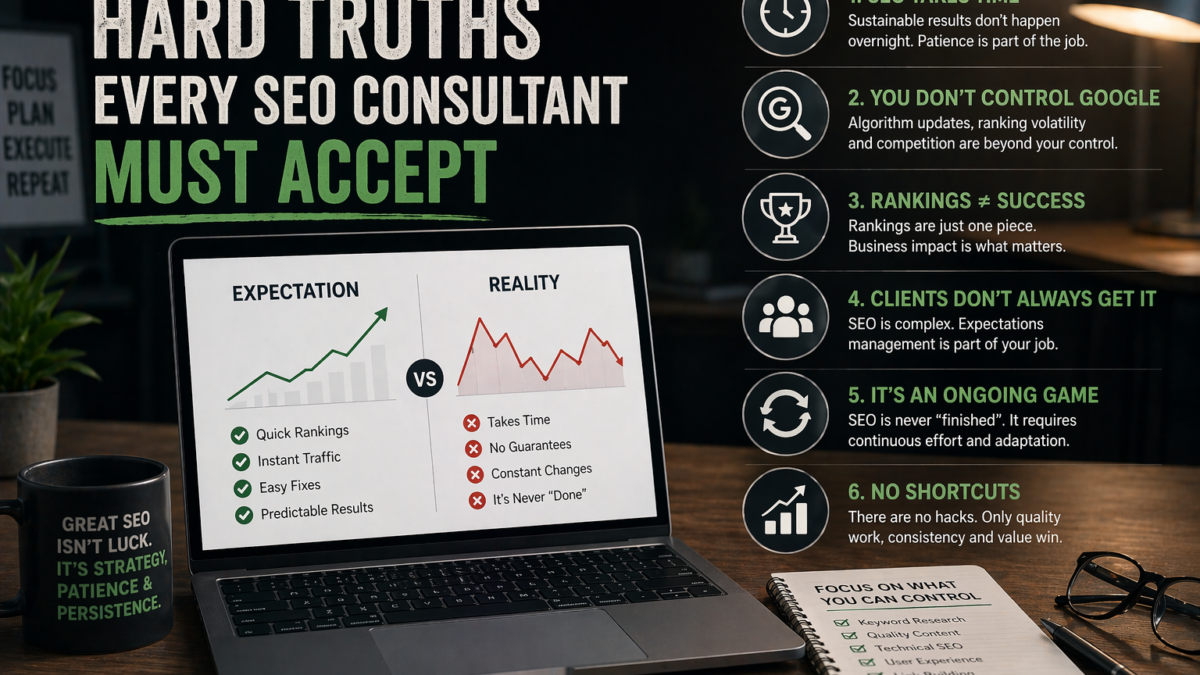
SEO has matured. What once felt like a technical advantage or clever workaround has evolved into a discipline that quickly exposes weak thinking and rewards those who understand users, systems, and long-term value.
In 2026, SEO consultants are no longer judged by tactics—they are judged by outcomes.
This guide is not about tools, hacks, or trends. Instead, it highlights the uncomfortable realities that separate effective SEO consultants from those who simply stay busy.
Accepting these truths is the difference between relevance and obsolescence.
Hard Truth #1: Rankings Don’t Equal Success
Many SEO consultants still define success by rankings.
However, rankings:
- Fluctuate constantly
- Vary by user, device, and intent
- Do not guarantee revenue
If rankings don’t support business goals, they are just noise. Consultants who fail to connect SEO efforts to measurable outcomes will eventually lose credibility.
Hard Truth #2: SEO Is No Longer a “Channel”
SEO does not operate in isolation anymore.
It intersects with:
- User Experience (UX)
- Product and website performance
- Branding and trust
- Content strategy
- Sales and conversion optimization
Treating SEO as a checklist or siloed service limits its real impact.
Hard Truth #3: Clients Don’t Want SEO — They Want Growth
Clients rarely care about:
- Meta tags
- Crawl reports
- Keyword density
They care about:
- Leads
- Revenue
- Market visibility
- Competitive advantage
If you cannot translate SEO into business results, you become replaceable.
Hard Truth #4: Volume Is a Trap
More pages, more keywords, and more traffic do not guarantee success.
High-volume strategies often create:
- Thin content
- Keyword cannibalization
- High maintenance overhead
Sustainable SEO prioritizes clarity, intent, and quality over scale.
Hard Truth #5: Most SEO Work Is Invisible
Great SEO is rarely flashy.
It often involves:
- Fixing structural issues no one notices
- Saying “no” to bad ideas
- Improving already-ranking content
- Removing unnecessary pages
Impactful work isn’t always visible—but it drives results.
Hard Truth #6: SEO Takes Longer Than Clients Expect
Even with perfect execution:
- Trust takes time
- Authority builds gradually
- Competitive gaps don’t close overnight
Overpromising speed destroys trust. Learn to sell patience with confidence.
Hard Truth #7: Tools Don’t Create Strategy
SEO tools provide data—not decisions.
Over-reliance on:
- Automated audits
- AI-generated insights
- Surface-level metrics
Leads to reactive SEO.
Strategy requires judgment, prioritization, and experience.
Hard Truth #8: Content Is Not the Same as Value
Publishing content does not mean helping users.
Search engines now evaluate:
- Depth
- Original insights
- Real-world experience
Move beyond content calendars—focus on content that changes understanding.
Hard Truth #9: SEO Is Now a Trust Game
Modern algorithms prioritize credibility.
Key trust signals include:
- Consistent messaging
- Clear authorship
- Brand authority
- User engagement
Businesses investing in trust-driven SEO strategies outperform those chasing technical shortcuts.
Hard Truth #10: Most Clients Are Over-Optimizing
Over-optimization remains a major issue.
Common mistakes:
- Forced keyword usage
- Excessive internal linking
- Repetitive content
Sometimes, the best SEO move is undoing past “optimization.”
Hard Truth #11: Not Every Client Is a Good Fit
Some businesses:
- Avoid investing in quality
- Expect shortcuts
- Ignore expert advice
Taking every client harms long-term credibility. Growth comes from alignment, not volume.
Hard Truth #12: SEO Is Political Inside Organizations
SEO decisions often conflict with:
- Design teams
- Product priorities
- Sales messaging
Success requires influence—not just technical skills.
Hard Truth #13: Authority Beats Cleverness
Clever tricks no longer win rankings.
Authority is built through:
- Consistency
- Depth
- Demonstrated expertise
Long-term authority always outperforms short-term tactics.
Hard Truth #14: Reporting Shapes Behavior
What you report determines what gets valued.
- Report traffic → You get traffic-focused actions
- Report rankings → You get short-term thinking
Define the right metrics to drive meaningful outcomes.
Hard Truth #15: SEO Consultants Must Become Strategists
Execution alone is not enough.
Modern SEO consultants must:
- Diagnose business problems
- Prioritize limited resources
- Connect SEO to revenue
Without strategy, execution loses value.
Hard Truth #16: Clients Are More Educated Than Ever
Today’s clients consume constant information.
Consultants must:
- Correct misinformation tactfully
- Explain trade-offs clearly
- Justify decisions with logic
Authority now comes from clarity—not confidence alone.
Hard Truth #17: SEO Has a Reputation Problem
The industry still carries baggage from:
- Overpromising results
- Black-hat tactics
- Inconsistent outcomes
Rebuilding trust requires transparency and restraint.
Hard Truth #18: The Market Is Crowded
Differentiation is essential.
Stand out through:
- Clear positioning
- Niche expertise
- Proven frameworks
Generic services no longer work.
Hard Truth #19: SEO Is Never “Done”
Search is constantly evolving:
- User behavior changes
- Competitors adapt
- Algorithms update
SEO is a system—not a one-time project.
Hard Truth #20: Longevity Requires Humility
The best consultants:
- Test assumptions
- Update strategies
- Admit failures
Curiosity compounds. Arrogance fades.
Conclusion
SEO in 2026 is less forgiving—but more rewarding for those who adapt.
It favors consultants who:
- Think deeply
- Communicate clearly
- Align work with real business outcomes
The future of SEO belongs not to those who know the most tactics—but to those who understand why SEO works—and why it doesn’t.
FAQs
Is SEO harder today than before?
Yes. SEO has become more complex because it now requires strategic thinking, user understanding, and long-term planning rather than just technical execution.
Are rankings still important?
Rankings still matter, but only when they contribute to real business outcomes like traffic quality, conversions, and revenue growth.
Can tools replace SEO consultants?
No. Tools provide valuable data, but they cannot replace human judgment, prioritization, and strategic decision-making.
Why do many SEO consultants struggle?
Many consultants struggle because they focus too much on tactics and metrics instead of aligning their work with business impact and measurable results.
What skill matters most for SEO consultants today?
Strategic thinking combined with clear communication is the most important skill, as it helps connect SEO efforts to real business value.
Leave a Reply