
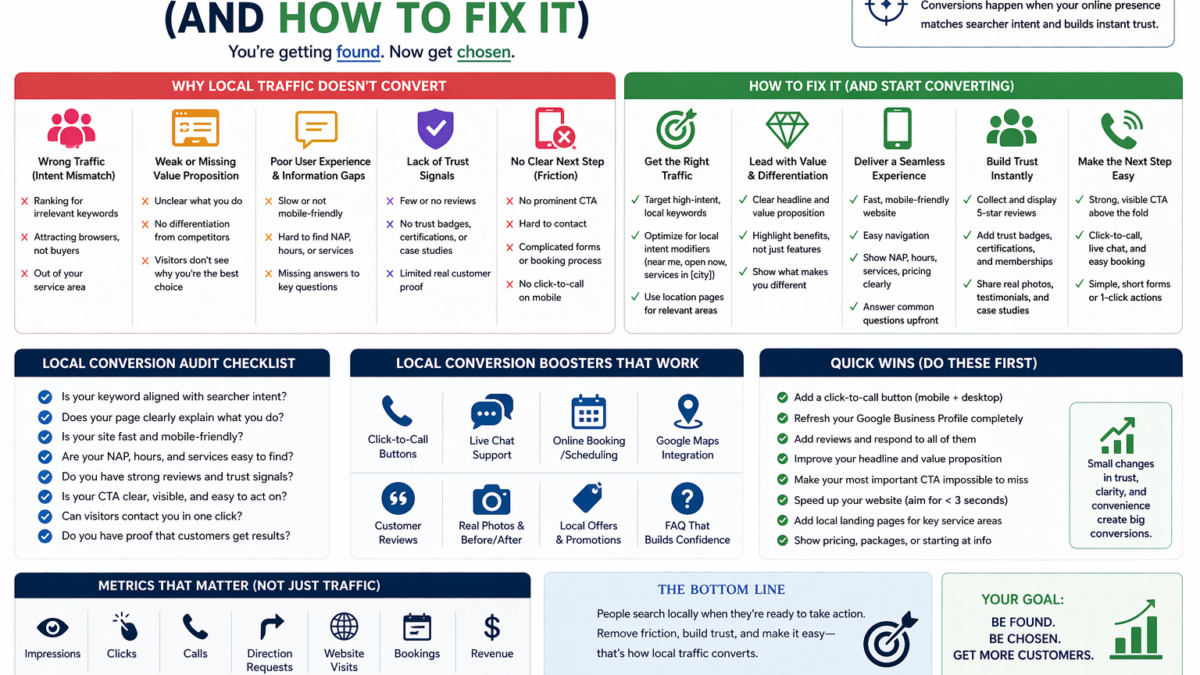
Many businesses in 2026 face a frustrating reality: their local SEO rankings look strong, impressions are growing, and Google Business Profile views are increasing—yet calls, inquiries, and walk-ins remain flat. This disconnect between visibility and revenue is one of the most common failures in local SEO today.
The problem is not traffic. The problem is misaligned intent, weak trust signals, and broken conversion paths. Search engines may deliver users to your site or listing, but it’s your responsibility to convince them to take action.
This blog breaks down why local traffic often fails to convert, what search engines now expect from local businesses, and how to fix conversion leaks without chasing more rankings.
Ranking Traffic vs Revenue Traffic
Not all local traffic is equal.
Many businesses rank for:
- Broad informational queries
- Early-stage comparison searches
- Low-urgency local keywords
These users are researching not ready to act.
High-converting local SEO focuses on decision-stage intent, not just location-based keywords.
The Biggest Misconception in Local SEO
The most dangerous assumption is:
“If we rank locally, customers will come.”
In reality:
- Users evaluate multiple businesses
- Trust is validated before contact
- Friction eliminates intent quickly
Search engines increasingly track post-click behavior, which means poor conversion performance can eventually hurt rankings too.
This is why businesses using Professional SEO services focus on conversion diagnostics not just keyword tracking.
Intent Mismatch: The Silent Conversion Killer
Local traffic often doesn’t convert because the page answers the wrong question.
Examples:
- A service page ranking for “best” queries without comparisons
- A homepage ranking for emergency searches with no urgency signals
- A location page ranking for pricing searches with no pricing clarity
When intent and content don’t align, users leave.
Lack of Trust Signals
Local decisions are trust-heavy.
Users look for:
- Reviews and ratings
- Proof of legitimacy
- Clear business identity
- Social validation
Pages without visible trust signals force users back to search results.
Search engines notice this behavior and adjust rankings accordingly.
Weak Google Business Profile Experience
Many businesses lose conversions directly on Google.
Common issues include:
- Incomplete profiles
- No photos or outdated images
- Unanswered reviews
- Missing services or categories
Your Google Business Profile is often the first conversion opportunity not your website.
Brands aligned with the Best SEO company treat GBP optimization as a conversion channel, not just a ranking asset.
Poor Mobile Conversion Paths
Local searches are overwhelmingly mobile.
Yet many sites still suffer from:
- Slow load times
- Tiny buttons
- Hidden contact details
- Complex forms
If users can’t call or navigate within seconds, they abandon.
Mobile UX is now a conversion prerequisite.
No Clear “Why You?” Messaging
Local users compare fast.
If your page doesn’t answer:
“Why should I choose you over the business next to you?”
You lose.
Strong local conversion messaging includes:
- Clear differentiation
- Service specialization
- Local experience proof
- Outcome-focused language
Generic claims don’t convert.
Overloaded or Underloaded Pages
Both extremes fail.
Conversion suffers when pages are:
- Overloaded with text and no hierarchy
- Too thin to inspire confidence
Effective local pages balance clarity, depth, and scannability.
Calls to Action That Don’t Match Intent
Many local pages fail because CTAs are wrong.
Examples:
- “Contact us” for emergency searches
- “Get a quote” for simple inquiries
- Long forms for quick decisions
CTAs must reflect urgency and effort tolerance.
Local Content Without Local Context
Swapping city names into generic content no longer works.
Local users expect:
- Area-specific references
- Local challenges or regulations
- Service relevance to their location
Search engines reward pages that feel genuinely local.
This is where a Top SEO agency focuses on contextual relevance, not template scaling.
Review Friction and Social Proof Gaps
Even one negative unanswered review can stop conversions.
Common review mistakes:
- Ignoring negative feedback
- No response strategy
- No review visibility on-site
Engagement with reviews builds both trust and rankings.
Tracking the Wrong Metrics
Many businesses track:
- Impressions
- Rankings
- Profile views
But ignore:
- Call tracking
- Direction clicks
- Conversion rate by page
You can’t fix what you don’t measure.
How to Diagnose Conversion Problems
Before fixing, diagnose.
Ask:
- Which queries bring traffic?
- Which pages receive local visits?
- Where do users drop off?
Conversion optimization starts with clarity.
Fixing Local Conversion Leaks
High-impact fixes include:
- Aligning pages to specific intent types
- Strengthening trust signals
- Simplifying mobile actions
- Improving GBP engagement
- Updating CTAs
These fixes often increase revenue without increasing traffic.
Why Conversion Optimization Improves Rankings
Search engines observe:
- Engagement depth
- Return-to-search behavior
- Interaction signals
Better conversions = stronger behavioral signals = more stable rankings.
Long-Term Benefits of Conversion-Focused Local SEO
When local SEO converts:
- Lead quality improves
- Ad dependency decreases
- Customer acquisition costs drop
- Growth becomes predictable
Visibility without conversion is wasted effort.
Conclusion
Local traffic doesn’t convert because most local SEO strategies stop at rankings. In 2026, search engines reward businesses that deliver relevance, trust, and ease of action not just proximity. Conversion failures are rarely caused by lack of traffic; they’re caused by lack of alignment.
Fixing conversion leaks transforms local SEO from a visibility tactic into a revenue engine.
FAQs
1. Why does my local SEO traffic not convert?
Usually due to intent mismatch, weak trust signals, or poor UX.
2. Does conversion rate affect local rankings?
Indirectly, yes—through engagement and behavior signals.
3. Should I optimize Google Business Profile for conversions?
Absolutely. It’s often the first decision point.
4. Are more reviews always better?
Quality, relevance, and response matter more than volume.
5. Can conversion optimization increase revenue without more traffic?
Yes, often significantly.
Leave a Reply