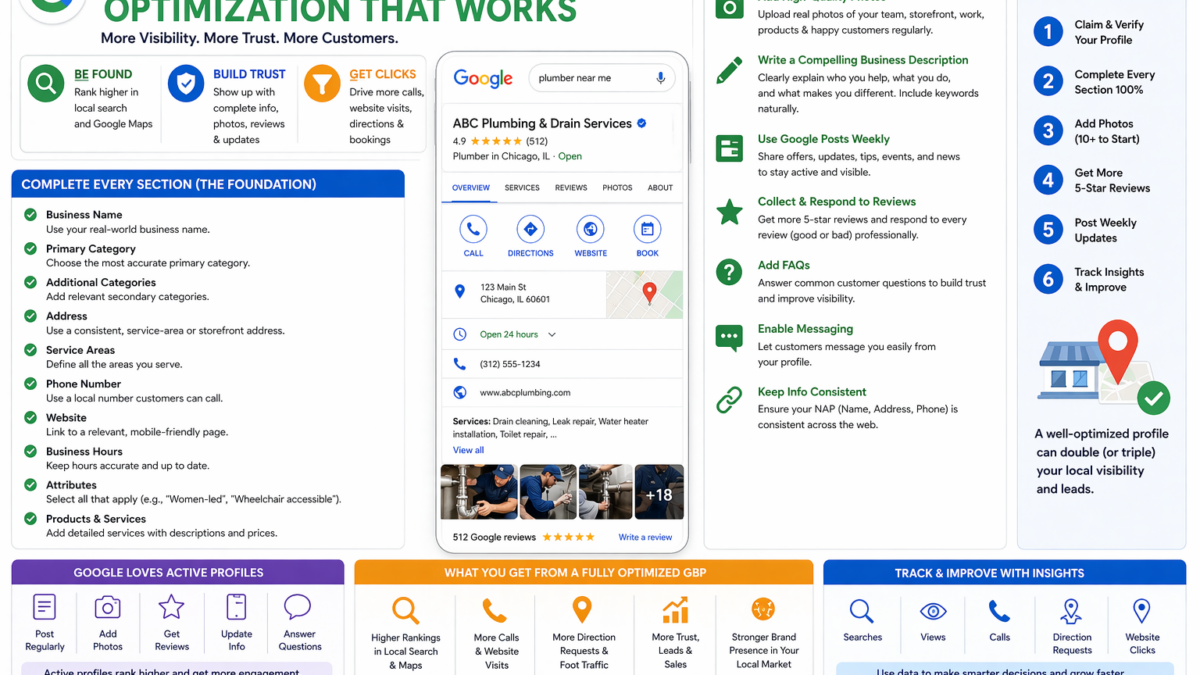
In 2026, Google Business Profile (GBP) is no longer just a directory listing—it is a decision-making platform. For many local searches, users never even visit a website. They read reviews, check photos, view services, and make a choice directly from Google’s interface.
Yet most businesses still treat GBP as a one-time setup task. They fill in basic details, upload a few photos, and expect results. This outdated approach leads to low engagement, weak conversions, and unstable local rankings.
This blog explains how Google Business Profile optimization actually works today, why most profiles underperform, and how to turn GBP into a consistent source of high-intent leads.
Why Google Business Profile Matters More Than Ever
Google increasingly keeps users inside its ecosystem.
GBP now influences:
- Local pack rankings
- Brand trust
- Call and direction actions
- Conversion decisions
For service-based and location-based businesses, GBP is often the first and last interaction before a user takes action.
Change block type or style
Move Paragraph block from position 12 up to position 11
Move Paragraph block from position 12 down to position 13
Change text alignment
Visibility vs Engagement: The Real Metric Shift
Many businesses track:
- Views
- Searches
- Impressions
But Google evaluates:
- Clicks
- Calls
- Direction requests
- Profile interactions
High visibility with low engagement signals irrelevance.
This is why businesses relying on Professional SEO services prioritize engagement optimization, not just exposure.
Core Elements of a High-Performing GBP
A strong profile is not defined by completeness alone.
It requires:
- Precise categorization
- Clear service definitions
- Fresh visual content
- Active review management
- Consistent posting behavior
Each element contributes to relevance and trust.
Category Selection: A Hidden Ranking Lever
Your primary category is one of the strongest ranking factors.
Mistakes include:
- Choosing broad categories
- Ignoring niche relevance
- Copying competitors blindly
Secondary categories should support not dilute your main offering.
Precision matters more than volume.
Services Section: Where Conversion Begins
The services section is often underused.
High-performing profiles:
- Break services into specific offerings
- Use user-facing language
- Align services with search intent
This section helps Google understand relevance and helps users decide faster.
Business Description: Stop Writing for Yourself
Most descriptions are:
- Generic
- Overly promotional
- Keyword-stuffed
Effective descriptions:
- Clearly state what you do
- Explain who you help
- Highlight credibility and experience
Clarity builds confidence.
Photos That Influence Decisions
Photos are not decorative they are conversion tools.
Profiles with active photo updates see:
- Higher engagement
- Longer profile interactions
- Increased trust
Best-performing photo types include:
- Real workspace images
- Team photos
- Service-in-action shots
- Updated exterior/interior visuals
Stock photos weaken credibility.
Reviews: More Than a Reputation Signal
Reviews now affect:
- Rankings
- Click-through rates
- Conversion confidence
What matters most:
- Consistency over time
- Keyword relevance in reviews
- Thoughtful responses
Brands aligned with the Best SEO company treat review responses as public-facing sales conversations.
Responding to Reviews Strategically
Review responses are indexed and visible.
Strong responses:
- Reinforce service value
- Address concerns calmly
- Highlight expertise subtly
Ignoring reviews positive or negative signals inactivity.
Google Posts: Still Underrated
Google Posts increase profile freshness.
Effective use cases:
- Service highlights
- Limited-time offers
- Educational updates
- Trust-building announcements
While not direct ranking boosters, posts improve engagement signals.
Q&A Section: Pre-Qualifying Leads
The Q&A section often contains unanswered questions or worse, incorrect answers.
Proactive optimization includes:
- Posting common questions yourself
- Providing clear, authoritative answers
- Addressing objections early
This reduces friction before contact.
Location Accuracy and Consistency
Small inconsistencies can cause big problems.
Common issues:
- Mismatched addresses
- Incorrect service areas
- Outdated hours
Consistency across platforms reinforces trust and ranking stability.
This is where a Top SEO agency focuses on data hygiene, not just optimization.
GBP and Website Alignment
GBP performance improves when:
- Landing pages match profile services
- Messaging is consistent
- CTAs align with intent
Disconnected profiles and websites reduce conversion rates.
Measuring What Actually Matters
Forget vanity metrics.
Track:
- Calls from GBP
- Direction requests
- Website clicks with intent
- Engagement trends
Optimization without measurement leads to guesswork.
Common GBP Mistakes That Kill Results
The most damaging mistakes include:
- Leaving profiles inactive
- Ignoring negative reviews
- Using incorrect categories
- Uploading outdated photos
These mistakes compound over time.
Turning GBP into a Lead Engine
High-performing profiles:
- Attract high-intent users
- Filter out poor-fit leads
- Reduce dependency on ads
- Strengthen local authority
GBP is not optional it’s foundational.
Future-Proofing Your Google Business Profile
To stay competitive:
- Update content regularly
- Monitor competitors
- Respond to user behavior changes
- Treat GBP as a living asset
Static profiles lose relevance quickly.
Conclusion
Google Business Profile optimization that works in 2026 is not about filling fields—it’s about building relevance, trust, and engagement at the exact moment users are ready to act. Businesses that treat GBP as a strategic conversion channel consistently outperform those who treat it as a listing.
When optimized correctly, GBP becomes one of the highest ROI assets in local SEO.
FAQs
1. Is Google Business Profile more important than a website?
For many local searches, yes, it’s often the first decision point.
2. How often should I update my GBP?
At least weekly with photos, posts, or review responses.
3. Do Google Posts help rankings?
Indirectly, through improved engagement signals.
4. Can negative reviews hurt rankings?
If unmanaged, yes, but good responses can mitigate impact.
5. Should service businesses without a storefront use GBP?
Yes, service-area profiles are still highly effective.
Leave a Reply