
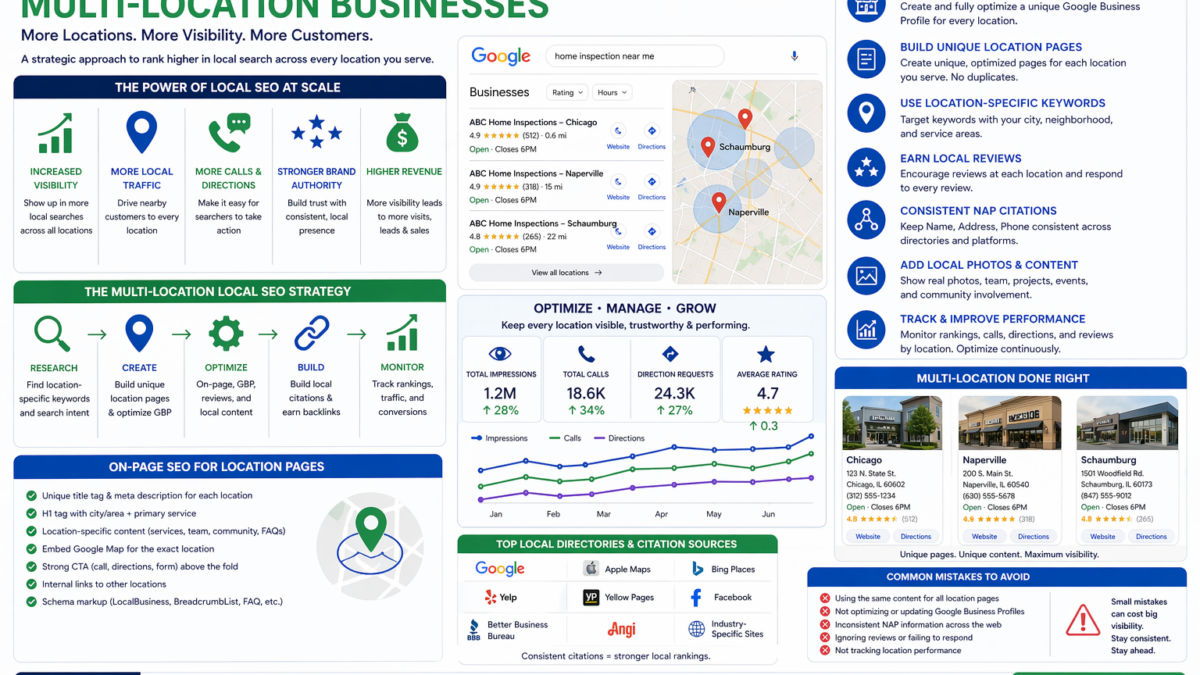
Managing local SEO for a single location is already complex. When a business operates across multiple cities, regions, or states, the challenge multiplies. Multi-location SEO is not just “local SEO at scale” it is an entirely different discipline that requires structure, governance, and long-term planning.
In 2026, search engines evaluate multi-location brands based on consistency, relevance, and local authority at each location level, not just brand strength at the national level. Businesses that fail to adapt often see uneven rankings, internal competition, and declining local visibility.
This blog breaks down how multi-location SEO actually works today, why most brands struggle with it, and how to build a scalable system that ranks and converts across every service area.
Why Multi-Location SEO Is Fundamentally Different
Single-location SEO focuses on dominance in one geographic area. Multi-location SEO focuses on controlled expansion without dilution.
The main challenges include:
- Duplicate or thin location pages
- Inconsistent business information
- Internal keyword cannibalization
- Weak local relevance signals
Search engines expect each location to prove its own legitimacy.
The Biggest Mistake: Treating Locations as Clones
Many brands create one location page and copy it across cities with minor edits.
This fails because:
- Google detects content duplication
- Local relevance signals are weak
- Users don’t feel a local connection
Each location must stand on its own while still aligning with the parent brand.
Location Page Architecture That Scales
A scalable structure is non-negotiable.
Effective architecture includes:
- A parent locations hub page
- Individual, indexable location URLs
- Logical internal linking
This helps search engines understand hierarchy and geographic relationships.
Content Strategy for Location Pages
Strong location pages answer three questions:
- Who are you locally?
- What do you offer here?
- Why should someone choose this location?
High-performing pages include:
- Local service variations
- Area-specific FAQs
- Nearby landmarks or service zones
This is where Professional SEO services focus on depth, not templates.
Avoiding Keyword Cannibalization Across Locations
Multi-location brands often rank poorly because pages compete with each other.
Common causes:
- Same keywords targeted on every page
- Overlapping service areas
- Weak internal linking signals
Each location page should target:
- Location-modified intent
- Unique service combinations
Clear differentiation improves rankings across the board.
Google Business Profiles at Scale
Managing dozens or hundreds of profiles requires systems.
Key principles:
- One verified profile per physical location
- Centralized monitoring
- Location-level optimization
Profiles must reflect the reality of each branch, not just corporate messaging.
Consistency Is a Ranking Signal
NAP consistency (Name, Address, Phone) becomes harder with scale.
Inconsistencies confuse:
- Search engines
- Users
- Map algorithms
Brands recognized as the Best SEO company treat local data management as infrastructure, not cleanup.
Reviews: Distributed Trust Building
Reviews should not be concentrated on one location.
Strong multi-location review strategies:
- Encourage reviews at every branch
- Respond locally, not generically
- Monitor sentiment patterns
Reviews act as proof of real-world presence.
Local Links for Each Location
National backlinks help branding, but local links drive local rankings.
Examples:
- Local news mentions
- Community partnerships
- Regional directories
Each location needs its own authority signals.
Internal Linking Between Locations
Smart internal linking strengthens geographic relevance.
Effective methods:
- Linking nearby locations
- State or region hub pages
- Contextual links within content
This helps distribute authority naturally.
Measuring Performance Location by Location
Aggregate reporting hides problems.
Track:
- Rankings per location
- GBP engagement by branch
- Calls and conversions per city
Multi-location SEO requires granular visibility.
Managing Scale Without Losing Quality
As locations grow, quality often drops.
To prevent this:
- Standardize processes, not content
- Use governance rules
- Audit locations regularly
This is where a Top SEO agency provides structure, not shortcuts.
Common Multi-Location SEO Failures
Avoid these mistakes:
- Thin or duplicate pages
- Centralized reviews only
- Ignoring underperforming locations
- Treating SEO as a one-time rollout
SEO at scale is ongoing.
Preparing for the Future of Local Search
In 2026 and beyond:
- AI evaluates local authenticity
- Engagement matters more than proximity
- Brand + local trust drives rankings
Multi-location brands must balance both.
Conclusion
Local SEO for multi-location businesses is about controlled expansion without sacrificing relevance. Each location must earn visibility on its own, supported by strong brand authority and consistent systems.
Businesses that invest in scalable structures, localized content, and disciplined execution build durable local dominance while those chasing shortcuts struggle with fragmentation and instability.
Multi-location SEO is not easy, but when done correctly, it becomes one of the strongest long-term growth channels available.
FAQs
1. Can one website rank for multiple cities?
Yes, with properly structured and unique location pages.
2. How many location pages are too many?
There is no limit quality and differentiation matter more than quantity.
3. Should every location have its own Google Business Profile?
Yes, if it represents a real, verifiable location.
4. Do all locations need unique content?
Yes. Thin or duplicated content weakens rankings.
5. How long does multi-location SEO take to work?
Typically 4–6 months, depending on competition and scale.
Leave a Reply