
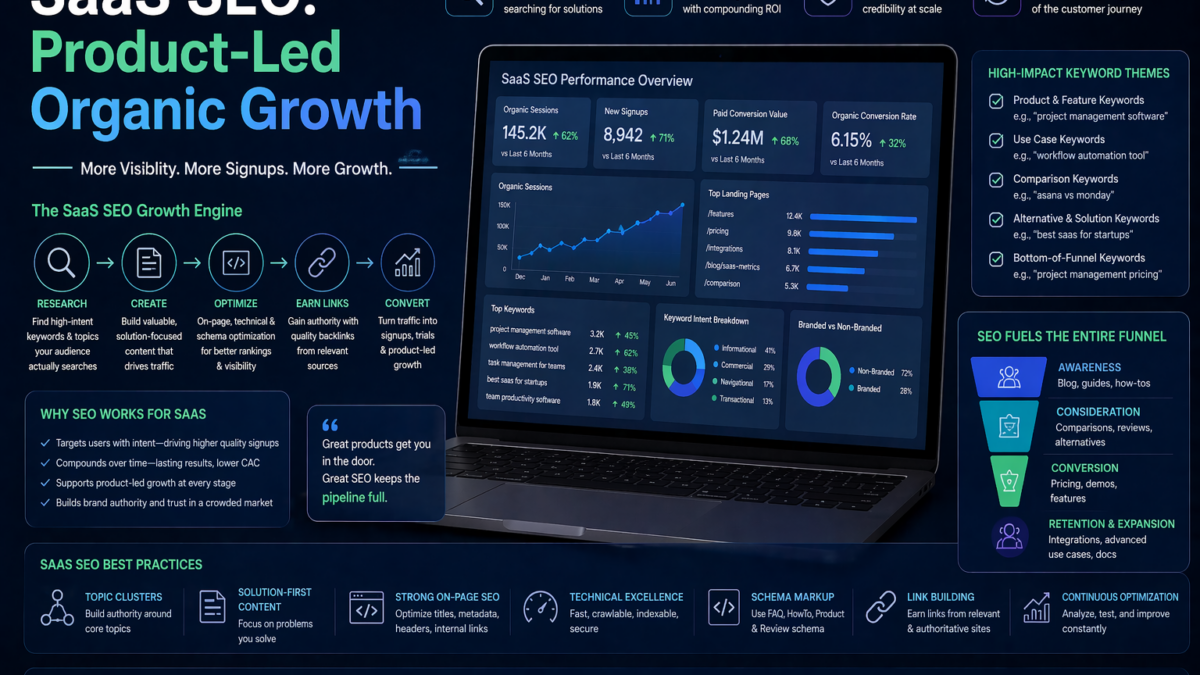
SaaS SEO in 2026 looks very different from traditional content-driven optimization. As software markets become saturated and paid acquisition costs continue to rise, SaaS companies are turning to product-led organic growth where the product itself becomes the primary driver of search visibility, adoption, and retention.
Ranking blog posts alone is no longer enough. Search engines increasingly reward SaaS brands that demonstrate real product value, clear use cases, and strong user engagement signals. The most successful SaaS companies integrate SEO into their product experience, not just their marketing funnel.
This blog explains how SaaS SEO works in 2026, why product-led strategies outperform content-only approaches, and how SaaS businesses can build scalable organic growth that compounds over time.
Why SaaS SEO Is Fundamentally Different
Unlike ecommerce or publishing, SaaS products solve ongoing problems.
Search engines evaluate:
- Product relevance
- User satisfaction
- Feature clarity
- Retention-driven engagement
A SaaS website that fails to clearly communicate product value rarely sustains rankings, no matter how strong its backlinks are.
Product-Led Growth Meets SEO
Product-led growth (PLG) focuses on:
- Self-serve onboarding
- Clear feature discovery
- Immediate value demonstration
SEO aligns naturally with PLG because search users are actively seeking solutions. When search intent matches product experience, conversions happen organically.
Why Blog-Only SaaS SEO Fails
Many SaaS companies rely heavily on blogs to drive traffic.
Common problems include:
- High traffic, low activation
- Informational users with no product intent
- Disconnected content and product pages
Search engines notice when users bounce without engaging—and rankings decline over time.
This is why teams investing in Professional SEO services increasingly restructure SaaS websites around product-led discovery rather than blog volume.
Understanding SaaS Search Intent
SaaS search intent is layered.
Key intent types include:
- Problem-aware searches
- Solution comparison
- Feature-specific queries
- Brand and product queries
High-performing SaaS SEO strategies create dedicated entry points for each intent instead of forcing all users through generic pages.
Feature Pages as SEO Assets
Feature pages are no longer just sales pages they are organic growth engines.
Effective feature pages:
- Address specific use cases
- Explain outcomes, not just functionality
- Include contextual examples
- Support both SEO and conversions
Search engines reward pages that clearly solve problems.
Use Case Pages Drive High-Intent Traffic
Use case pages capture users closer to activation.
Strong use case content:
- Aligns with real-world workflows
- Demonstrates product application
- Reduces friction in decision-making
This is often where SaaS companies outperform competitors working with the Best SEO company by structuring content around user needs, not keywords.
Internal Linking Between Product and Content
SEO and product experience must be connected.
Effective internal linking:
- Guides users from content to product features
- Reinforces topical authority
- Improves engagement signals
Disconnected blogs and product pages dilute both SEO and conversions.
Technical SEO in SaaS Environments
SaaS platforms often rely on:
- JavaScript-heavy interfaces
- Dynamic content rendering
- App subdomains
SEO requires:
- Crawlable marketing pages
- Controlled indexation
- Clear separation between app and marketing content
Technical clarity supports product-led visibility.
Freemium and SEO: A Powerful Combination
Freemium models naturally align with organic search.
Benefits include:
- Lower conversion barriers
- Higher engagement signals
- Stronger brand searches
Search engines reward SaaS brands that demonstrate real usage and satisfaction.
Content That Supports Activation
SaaS content should reduce onboarding friction.
High-value content includes:
- Setup guides
- Feature tutorials
- Integration explanations
- Troubleshooting resources
These assets attract users who are ready to adopt not just read.
SEO Metrics That Actually Matter for SaaS
Traffic alone is misleading.
SaaS SEO success should be measured by:
- Activation rate
- Feature engagement
- Trial-to-paid conversion
- Retention signals
Search engines increasingly correlate engagement with ranking stability.
Scaling SaaS SEO Without Dilution
As SaaS platforms grow, SEO risks increase.
Common scaling issues:
- Thin feature pages
- Duplicate integrations
- Auto-generated content
Scalable SaaS SEO requires disciplined content governance and intent mapping.
This is where a Top SEO agency focuses on structure rather than volume.
Long-Term Compounding Benefits
Product-led SEO compounds because:
- Users generate brand demand
- Content supports adoption
- Search visibility reinforces trust
Over time, organic growth becomes predictable and defensible.
Why Patience Is Critical in SaaS SEO
SaaS buying cycles vary.
SEO gains take time because:
- Trust builds gradually
- Engagement data accumulates
- Product usage validates relevance
Short-term expectations often sabotage long-term success.
Future-Proofing SaaS SEO
SaaS SEO strategies that last:
- Align product and search intent
- Prioritize clarity over cleverness
- Invest in experience, not tricks
Algorithms change user needs don’t.
Conclusion
SaaS SEO in 2026 is no longer about content volume or keyword coverage. It’s about embedding SEO into the product experience itself. Product-led organic growth creates alignment between what users search for, what the product delivers, and what search engines reward.
SaaS companies that treat SEO as a growth system—not a marketing channel—build sustainable visibility that scales with their product.
FAQs
1. Is SaaS SEO different from traditional SEO?
Yes. SaaS SEO focuses on product value, activation, and engagement.
2. Are blogs still useful for SaaS SEO?
Yes, but only when they support product discovery and adoption.
3. How long does SaaS SEO take to work?
Typically 3–6 months for early traction, longer for competitive markets.
4. Do feature pages really rank?
Yes, when aligned with clear user intent.
5. What’s the biggest SaaS SEO mistake?
Driving traffic without a product-led conversion path.
Leave a Reply