
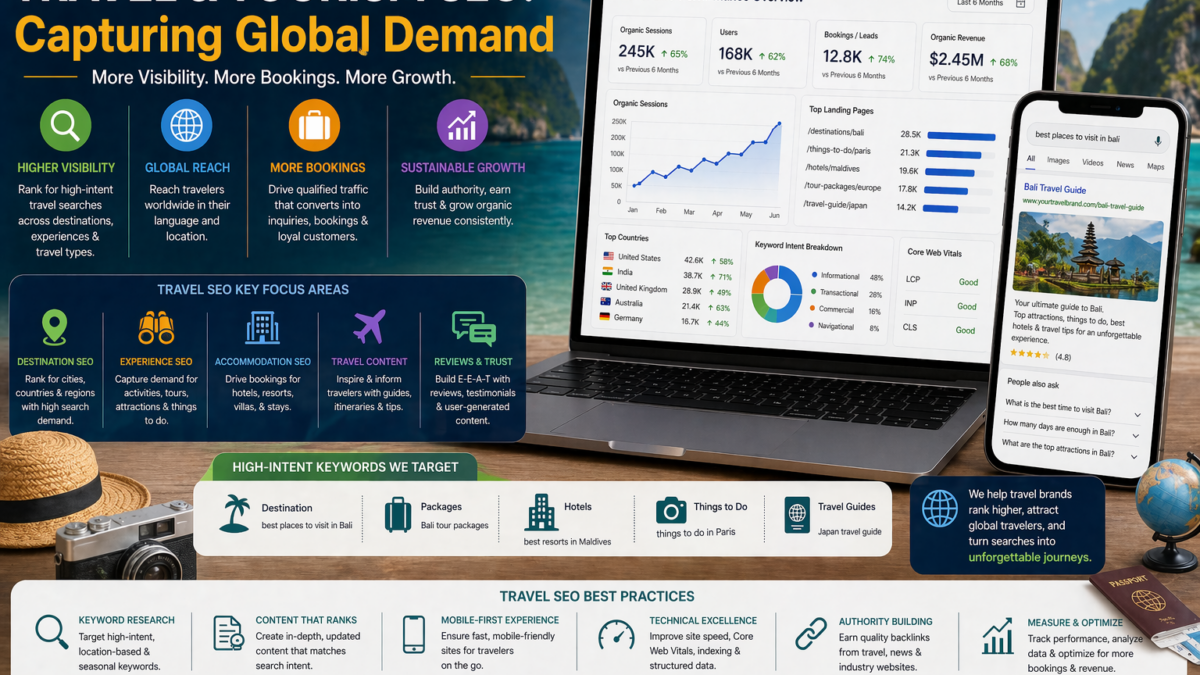
Travel and tourism SEO in 2026 operates in one of the most competitive and volatile digital landscapes. Search demand is global, seasonality is intense, and user expectations are higher than ever. Travelers no longer search only for destinations they search for experiences, authenticity, safety, and value before making decisions that often involve significant spending.
Ranking in travel SEO is no longer about publishing destination blogs or stuffing city names into pages. Search engines now evaluate experience depth, trustworthiness, real-world usefulness, and user engagement signals. Brands that fail to align with traveler intent struggle to convert impressions into bookings.
This blog explains how travel and tourism SEO works today, why many brands lose visibility despite strong demand, and how a strategy-led approach helps capture global organic traffic sustainably.
Why Travel SEO Is Uniquely Competitive
Travel search results are crowded with:
- Global booking platforms
- Aggregators and OTAs
- Government tourism boards
- Local operators and niche brands
Search engines must decide which sources provide the most value to travelers not just which sites are optimized.
As a result, authority, relevance, and experience matter more than raw keyword targeting.
Understanding Global Travel Search Behavior
Travel searches vary dramatically based on:
- Geography
- Season
- Budget level
- Travel intent
A single destination keyword can represent:
- Inspiration-stage browsing
- Comparison-stage planning
- Ready-to-book intent
Treating all travel searches the same leads to low engagement and unstable rankings.
Why Most Travel Websites Don’t Convert Organic Traffic
Common travel SEO failures include:
- Generic destination content
- Overlapping city and attraction pages
- No differentiation from OTAs
- Weak trust and experience signals
Search engines notice when users bounce or continue searching—and rankings adjust accordingly.
Brands that invest in Professional SEO services often discover that poor intent mapping, not competition, is the real barrier to growth.
Search Intent Is the Core of Travel SEO
Travel SEO must map content to intent precisely.
Primary intent types include:
- Inspiration (where to go, best places)
- Planning (itineraries, seasons, costs)
- Comparison (hotels, tours, packages)
- Transactional (booking, availability)
High-performing travel sites create separate content layers for each stage instead of forcing everything into one page.
Experience-Based Content Outperforms Generic Guides
Search engines now reward content that demonstrates lived or operational experience.
Strong experience signals include:
- First-hand insights
- Practical travel advice
- Local context
- Real constraints and tips
Generic content rewritten from other sources rarely sustains rankings.
This approach aligns closely with how the Best SEO company structures travel content experience first, keywords second.
Destination Pages Must Do More Than Rank
In 2026, destination pages function as decision hubs.
Effective destination pages:
- Answer safety, timing, and cost concerns
- Highlight unique value propositions
- Provide planning clarity
- Support multiple user intents
Thin destination pages struggle to compete against authoritative platforms.
Local SEO and Geo-Relevance in Travel
Even global travel brands rely heavily on local signals.
Local SEO matters for:
- Tour operators
- Hotels
- Travel agencies
- Experience providers
Accurate location data, local reviews, and geo-relevant content increase both visibility and trust.
Trust Signals Matter More Than Ever
Travel involves risk financial and experiential.
Search engines evaluate trust through:
- Reviews and ratings
- Brand mentions
- External citations
- Content transparency
Weak trust signals suppress rankings, especially for high-cost bookings.
This is where a Top SEO agency focuses beyond rankings on reputation and credibility building.
Seasonality and SEO Planning
Travel demand is seasonal, but SEO should not be reactive.
Effective travel SEO:
- Publishes content ahead of peak seasons
- Maintains evergreen planning resources
- Updates seasonal relevance regularly
Waiting for demand spikes often means missing them.
Technical SEO in Travel Websites
Travel platforms often include:
- Dynamic pricing
- Availability calendars
- JavaScript-heavy interfaces
SEO-friendly travel sites ensure:
- Crawlable core content
- Stable URLs
- Fast performance across regions
- Mobile-first usability
Technical stability supports global visibility.
Structured Data for Travel SEO
Structured data helps search engines understand:
- Destinations
- Accommodations
- Reviews
- Events and experiences
Correct markup improves clarity, while incorrect implementation can reduce trust.
Content Localization vs Translation
Global travel SEO requires localization—not simple translation.
Localization includes:
- Cultural context
- Regional search behavior
- Local terminology
- Seasonal relevance
Search engines favor content that feels native to the searcher.
Competing With OTAs and Aggregators
Smaller brands cannot outspend OTAs but they can out-specialize them.
Successful strategies include:
- Niche experience focus
- Local expertise
- Unique itineraries
- Personalized content
Search engines reward differentiation, not duplication.
Measuring Travel SEO Success Correctly
Travel SEO success is not just traffic volume.
Meaningful metrics include:
- Booking intent signals
- Engagement depth
- Conversion readiness
- Brand searches
High impressions without bookings indicate strategic gaps.
Why Travel SEO Takes Time
Trust, authority, and seasonal alignment take time to build.
Travel SEO growth is slower because:
- Competition is global
- Decisions are high-stakes
- Search engines are cautious
Short-term tactics rarely survive peak-season competition.
Long-Term Value of Strategy-First Travel SEO
When done right, travel SEO:
- Reduces dependency on paid channels
- Builds global brand authority
- Creates predictable demand
- Compounds year over year
Sustainable visibility beats seasonal spikes.
Conclusion
Travel and tourism SEO in 2026 is about capturing demand by earning trust. Search engines reward brands that deliver real value, authentic experience, and clarity throughout the traveler journey. Ranking alone does not drive bookings alignment does.
Brands that treat SEO as a long-term growth system, not a seasonal tactic, build resilient global visibility that withstands competition and algorithm changes.
FAQs
1. Is SEO still effective for travel businesses?
Yes, but only with strong intent alignment and trust signals.
2. How long does travel SEO take to show results?
Typically 4–9 months, depending on competition and authority.
3. Can small travel brands compete with OTAs?
Yes, by focusing on niche experiences and local expertise.
4. Does seasonality affect rankings?
Yes, but evergreen planning content helps maintain stability.
5. What is the biggest mistake in travel SEO?
Publishing generic content without differentiation or experience.
Leave a Reply