
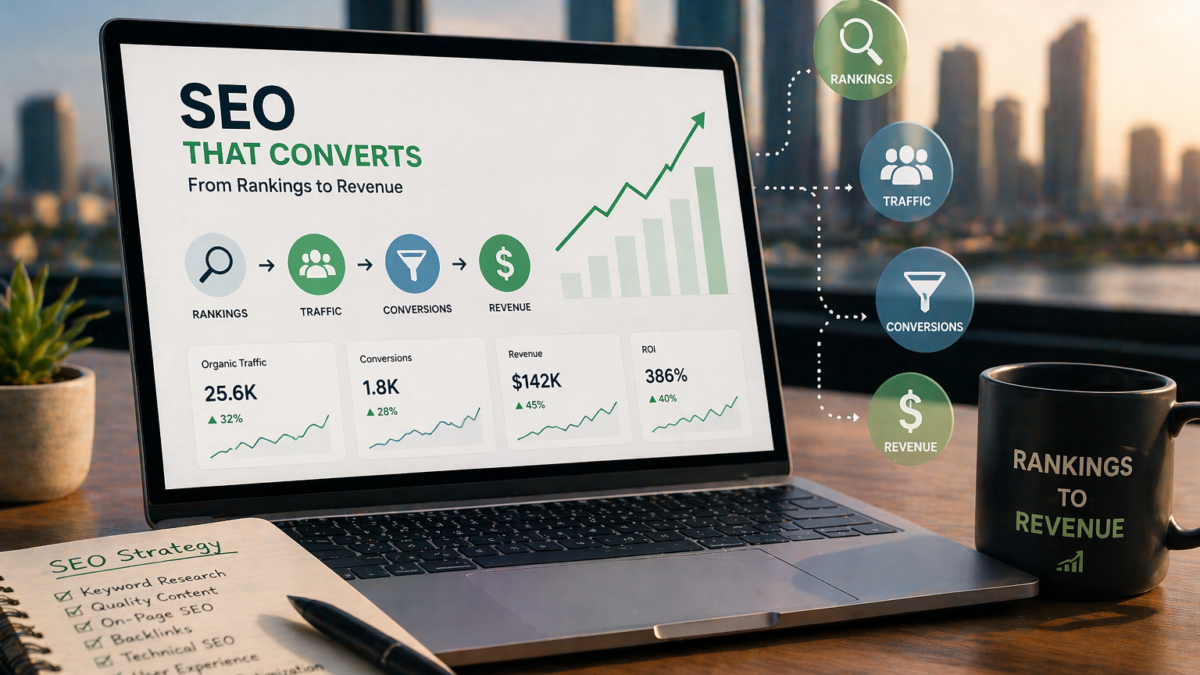
For years, SEO success was measured by rankings, impressions, and traffic growth. While those metrics still matter, they no longer define real business impact. In 2026, search visibility without conversions is a liability, not a win. Businesses that focus only on ranking charts often discover that traffic alone does not translate into leads, sales, or long-term growth.
Modern SEO must be designed to influence decisions, not just attract clicks. This blog explores how SEO has evolved from a visibility channel into a revenue-driving system, and what it takes to make that transition successfully.
Why Rankings Alone Don’t Build Businesses
Ranking on page one feels like success but rankings don’t pay salaries.
Common problems with ranking-focused SEO:
- High traffic, low conversions
- Poor lead quality
- Misaligned intent
- Sales teams blaming “bad leads”
These issues occur when SEO is disconnected from business outcomes. Search engines reward relevance, but revenue comes from alignment with buyer intent.
The Shift: SEO as a Revenue Channel
In 2026, SEO is no longer a standalone marketing tactic. It sits at the center of:
- Demand generation
- Brand authority
- Sales enablement
- Customer education
Search visibility now supports the entire buying journey, not just the awareness stage.
Understanding Conversion-Oriented SEO
Conversion-focused SEO answers one core question:
Why should this visitor take action now?
That means optimizing for:
- Intent clarity
- Trust signals
- Decision-stage content
- Clear next steps
SEO that converts is designed backward from revenue goals to keywords not the other way around.
Intent Is the Real Ranking Factor
Not all keywords are equal.
High-conversion SEO prioritizes:
- Problem-aware searches
- Solution-comparison queries
- Purchase-ready intent
Ranking #1 for the wrong keyword produces traffic that never converts.
Content That Moves Users Forward
Revenue-driven content does more than inform it guides.
Effective SEO content:
- Anticipates objections
- Explains outcomes, not features
- Reduces perceived risk
- Supports decision-making
This is where many blogs fail: they educate but never advance the buyer.
SEO and Funnel Alignment
SEO supports every funnel stage when mapped correctly.
- Top-of-funnel: Awareness and problem definition
- Mid-funnel: Evaluation and comparison
- Bottom-of-funnel: Decision and validation
Most websites overload the top and ignore the bottom losing revenue in the process.
The Role of Trust in SEO Conversions
Traffic converts only when users trust what they see.
Search engines evaluate trust through:
- Content depth
- Brand consistency
- Behavioral signals
- Authority indicators
Businesses investing in Professional SEO services often outperform competitors because trust-building is baked into the strategy, not added later.
UX: The Hidden Conversion Multiplier
Even the best-ranking page fails if the experience is poor.
Conversion-critical UX elements include:
- Clear navigation
- Fast load times
- Mobile-first design
- Focused calls to action
SEO and UX now function as a single system.
From Informational to Commercial Pages
Many sites rank with blogs but sell with service pages.
Revenue SEO ensures:
- Commercial pages rank for buying intent
- Blogs support not replace conversion pages
- Internal links guide users toward action
Traffic without commercial pathways leaks value.
Measuring SEO Beyond Traffic
Vanity metrics hide real performance.
Revenue-focused SEO tracks:
- Conversion rate by keyword
- Assisted conversions
- Lead quality
- Pipeline contribution
This data reshapes content priorities and keyword targeting.
Why Most SEO Agencies Miss Revenue
Many SEO campaigns fail because they:
- Focus on volume, not intent
- Separate SEO from sales goals
- Avoid accountability for conversions
Businesses working with the Best SEO company typically see better ROI because success is measured in outcomes, not reports.
SEO and Sales Team Alignment
High-performing SEO strategies collaborate with sales.
This alignment ensures:
- Keyword strategy reflects real buyer questions
- Content addresses sales objections
- Leads arrive more educated
SEO becomes a sales enablement tool, not just a traffic source.
Long-Term Revenue Compounding
SEO conversions compound over time.
Unlike ads:
- Rankings build authority
- Content assets increase in value
- Cost per acquisition decreases
This is why SEO remains one of the highest-ROI channels when executed strategically.
Choosing the Right SEO Partner
Conversion-driven SEO requires strategic leadership.
Businesses guided by a Top SEO agency one that understands buyer psychology, funnels, and revenue metrics consistently outperform those chasing traffic alone.
The Future of SEO Conversions
By 2027:
- Intent accuracy will outweigh ranking position
- Conversion optimization will influence rankings
- Revenue attribution will define SEO success
SEO teams will be judged by business impact, not visibility.
Conclusion
SEO that converts is not about more traffic it’s about better traffic. Rankings are only valuable when they attract the right audience, at the right stage, with the right message.
Businesses that align SEO with revenue strategy turn search engines into predictable growth engines. Those that don’t will continue celebrating metrics that never reach the bottom line.
FAQs
1. Can SEO directly generate revenue?
Yes, when keywords, content, and UX are aligned with buyer intent.
2. Why doesn’t high traffic convert?
Because traffic often lacks intent or trust alignment.
3. Is SEO better than paid ads for revenue?
SEO compounds over time and often delivers higher long-term ROI.
4. How long does conversion-focused SEO take?
Initial improvements in 3–6 months, compounding thereafter.
5. What’s the biggest mistake in SEO today?
Optimizing for rankings instead of outcomes.
Leave a Reply