
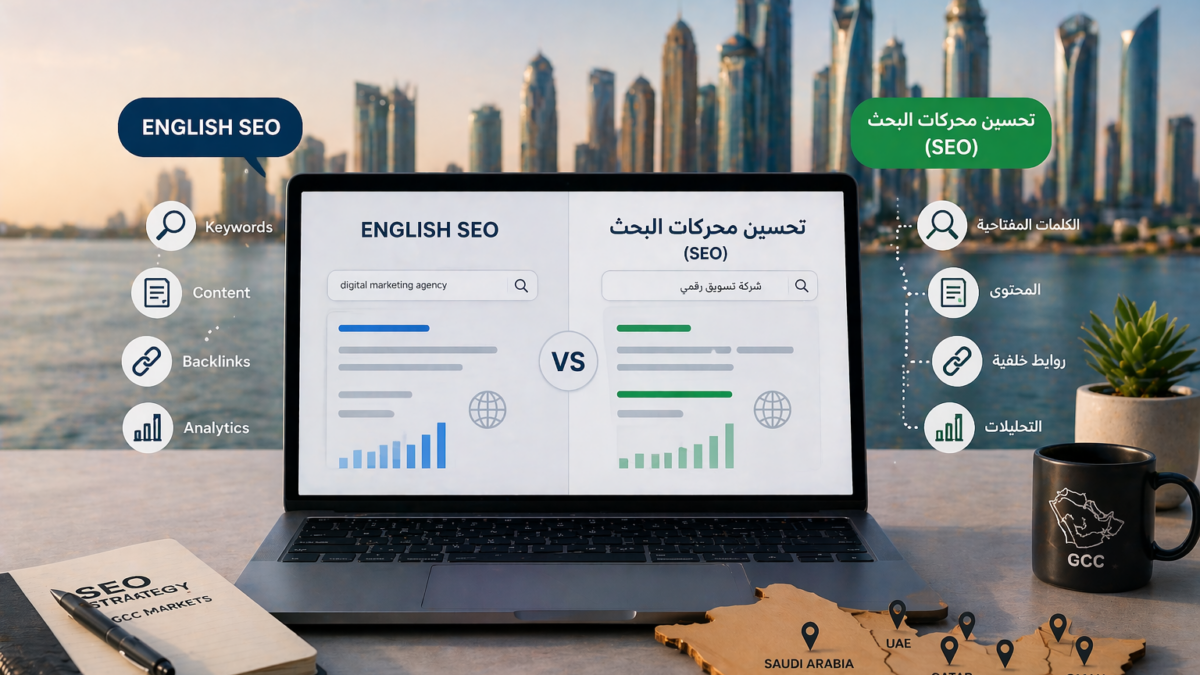
Search behavior across the Gulf is often misunderstood. Many businesses assume that English-only SEO is enough, while others believe Arabic content alone guarantees local reach. In reality, SEO success in GCC countries depends on intent, audience segmentation, and contextual language strategy not translation.
Across the Gulf Cooperation Council (GCC), search engines evaluate how well content matches user expectations, cultural nuance, and decision-making behavior. In 2026, bilingual SEO is no longer a language choice it’s a strategic architecture decision.
Why Language Strategy Matters in GCC SEO
Arabic and English searches do not compete with each other they serve different intents.
Search engines distinguish:
- Commercial vs informational intent
- Local trust vs global credibility
- Consumer vs enterprise behavior
Choosing the wrong language for the wrong intent leads to poor rankings and low conversions.
Understanding Search Intent by Language
In most GCC markets:
- English searches dominate B2B, technology, finance, aviation, and enterprise services
- Arabic searches dominate local services, healthcare, education, and government-related queries
SEO strategies must align language with decision-making context, not brand preference.
Arabic SEO: Trust, Locality, and Cultural Relevance
Arabic SEO builds trust.
It performs best when:
- Content is culturally contextualized (not translated)
- Local phrasing reflects real usage
- Tone aligns with regional expectations
Search engines increasingly reward content that demonstrates cultural fluency, especially for YMYL and service-based industries.
English SEO: Authority, Precision, and Enterprise Reach
English SEO remains critical for:
- Corporate decision-makers
- Multinational audiences
- High-value B2B services
English-language content signals global professionalism, technical depth, and compliance factors search engines associate with authority.
Translation Is Not SEO
One of the biggest GCC SEO mistakes is direct translation.
Problems include:
- Misaligned keywords
- Incorrect intent targeting
- Loss of semantic meaning
Search engines treat translated content without localization as low-value duplication.
Country-Level Differences Within the GCC
Language dominance varies by market:
- UAE and Qatar lean heavily bilingual
- Saudi Arabia favors Arabic for consumer services
- Bahrain and Oman show mixed but intent-driven behavior
A single-language strategy rarely performs well across all GCC countries.
Technical SEO Challenges in Bilingual Websites
Common technical mistakes include:
- Duplicate content across languages
- Incorrect hreflang implementation
- Poor URL structures
Without clean technical execution, even high-quality bilingual content fails to rank.
Content Architecture for Bilingual SEO
Effective GCC websites:
- Separate language content strategically
- Align pages with intent, not symmetry
- Avoid one-to-one page duplication
This architecture improves crawl efficiency and ranking stability.
Local SEO and Language Signals
Local SEO success often depends on Arabic signals:
- Business profiles
- Reviews
- Location-based queries
Companies investing in Professional SEO services Oman often see stronger local traction when Arabic SEO is handled strategically rather than as an afterthought.
Conversion Behavior Differs by Language
Arabic users:
- Spend more time validating trust
- Respond better to reassurance and clarity
English users:
- Prioritize efficiency and expertise
- Convert faster with structured information
SEO must support both behaviors differently.
Backlinks and Language Authority
Arabic backlinks and English backlinks behave differently.
Search engines evaluate:
- Language relevance of linking domains
- Contextual alignment
- Geographic trust
A balanced backlink profile strengthens bilingual authority.
Cost Efficiency in Emerging GCC Markets
In less saturated markets, bilingual SEO delivers high ROI.
Businesses adopting Affordable SEO services Bahrain-style cost-efficient, intent-focused strategies often outperform competitors overspending on volume without structure.
Measuring Success in Bilingual SEO
Key metrics include:
- Language-specific keyword growth
- Engagement by language
- Conversion paths per audience segment
Combined traffic numbers alone are misleading.
The Role of Strategic SEO Leadership
Bilingual SEO requires governance.
Organizations guided by an experienced SEO expert in Qatar-level strategic mindset focused on intent mapping, architecture, and authority achieve long-term dominance across GCC SERPs.
The Future of Language SEO in the GCC
By 2027:
- Search engines will better interpret dialects
- Cultural relevance will impact rankings more
- Intent accuracy will outweigh content volume
Language strategy will become a competitive moat.
Conclusion
Arabic vs English SEO is not a choice it’s a framework. GCC businesses that align language with intent, trust, and technical precision outperform those relying on translation or assumptions.
SEO success in the GCC belongs to brands that respect how users search, decide, and trust—in the language that matters to them.
FAQs
1. Is Arabic SEO mandatory in the GCC?
Not always, but critical for local and trust-driven searches.
2. Can English-only websites rank in GCC countries?
Yes, for enterprise and global audiences—but with limits.
3. Does translation hurt SEO?
Yes, if not localized and intent-aligned.
4. How should bilingual sites structure content?
By intent, not symmetry.
5. What is the biggest mistake in GCC language SEO?
Assuming one language fits all audiences.
Leave a Reply