
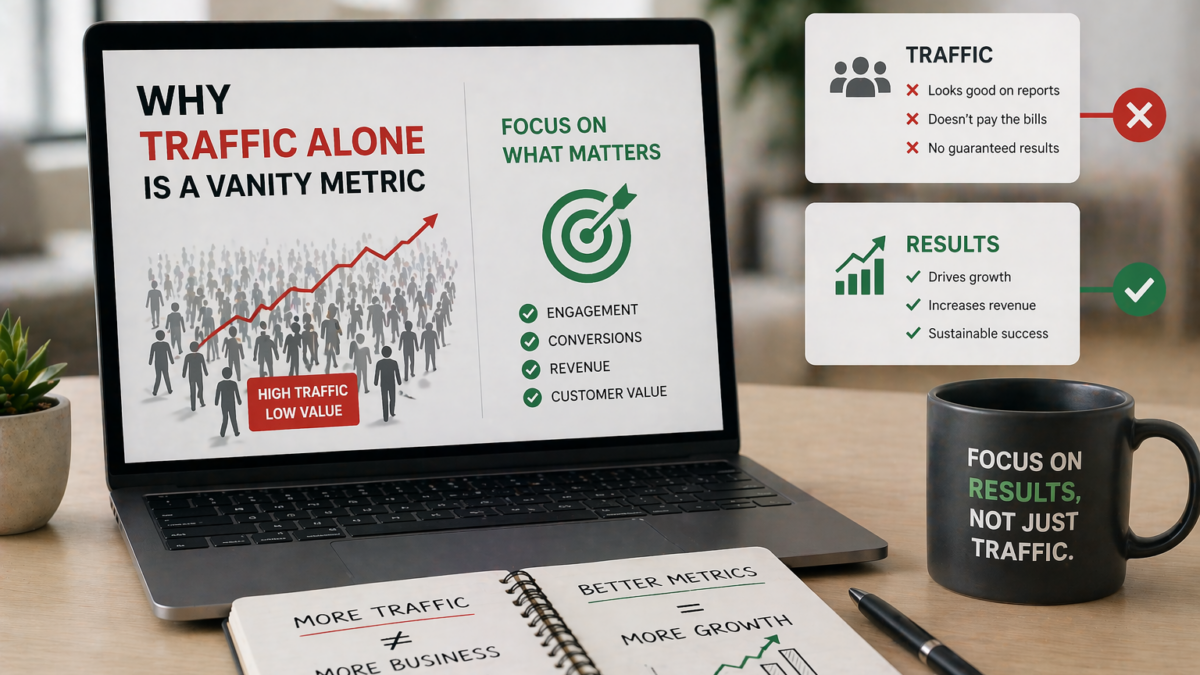
For a long time, traffic growth has been treated as the ultimate indicator of SEO success. Monthly reports celebrate rising sessions, impressions, and clicks as proof that a strategy is working. Yet many businesses experience a frustrating reality: traffic goes up, but revenue does not.
In 2026, this gap between visibility and value has become impossible to ignore. Traffic without outcomes is no longer a success metric it’s a distraction. This blog explains why traffic alone is a vanity metric, how it misleads decision-makers, and what businesses should measure instead.
The Illusion of Growth
Traffic numbers feel good because they are easy to understand.
More visitors seem to imply:
- More awareness
- More opportunities
- More future revenue
But SEO performance is not linear. Ten thousand irrelevant visitors are less valuable than one hundred high-intent ones. When traffic is disconnected from business goals, it creates a false sense of progress.
What Makes a Metric “Vanity”
A vanity metric looks impressive but fails to drive decisions.
Traffic becomes a vanity metric when:
- It doesn’t correlate with leads or sales
- It masks low conversion rates
- It shifts focus away from intent and quality
High traffic with low engagement often signals misalignment, not success.
The Core Problem: Intent Mismatch
Most traffic-heavy SEO strategies chase:
- Broad keywords
- Informational queries
- High search volume
These visitors are often researching, browsing, or learning—not buying. Without intent alignment, traffic inflates numbers while deflating ROI.
Traffic vs Business Outcomes
Businesses don’t grow on visits they grow on actions.
Real growth metrics include:
- Qualified leads
- Sales conversations
- Demo requests
- Revenue contribution
If traffic doesn’t move users closer to these outcomes, it adds operational noise rather than value.
How Traffic Obscures Real Problems
High traffic can hide critical weaknesses:
- Poor messaging
- Weak trust signals
- Ineffective offers
- Broken funnels
Because reports “look good,” deeper issues remain unresolved, costing businesses months or years of lost opportunity.
The Cost of Chasing Volume
Volume-driven SEO strategies often lead to:
- Content bloat
- Thin pages targeting similar keywords
- Bloated analytics dashboards
This creates maintenance overhead without proportional returns. Businesses end up managing complexity instead of driving results.
Engagement Reveals Truth
Engagement metrics tell a more honest story than traffic.
Key indicators include:
- Time on page
- Scroll depth
- Return visits
- Conversion paths
Low engagement paired with high traffic is a warning sign not a win.
SEO Should Filter, Not Flood
Effective SEO acts as a filter.
It attracts:
- The right audience
- At the right stage
- With the right expectations
Businesses that invest in Professional SEO services typically see fewer but more valuable visitors because intent filtering is built into keyword and content strategy.
The Role of Buyer Context
Traffic metrics ignore buyer context.
A visitor researching definitions behaves very differently from someone comparing solutions or evaluating vendors. Treating them as equal inflates numbers but dilutes strategy.
SEO must recognize where the visitor is in the decision process.
Conversion Rate > Traffic Volume
A modest increase in conversion rate often delivers more value than doubling traffic.
For example:
- 2% conversion on 5,000 visits = 100 leads
- 5% conversion on 3,000 visits = 150 leads
Traffic-focused strategies rarely optimize this leverage point.
When Traffic Actually Matters
Traffic is not useless it’s incomplete.
Traffic matters when:
- It aligns with intent
- It feeds a defined funnel
- It supports measurable outcomes
The problem isn’t traffic itself, but treating it as the final goal.
Reporting That Drives the Wrong Behavior
When teams are rewarded for traffic growth, they optimize for:
- Clicks over conversions
- Volume over relevance
- Speed over sustainability
This is why businesses working with the Best SEO company often shift reporting away from traffic and toward revenue-linked KPIs.
SEO as a Business System
In modern organizations, SEO supports:
- Sales enablement
- Demand generation
- Brand trust
- Customer education
Traffic is only the entry point not the destination.
What to Measure Instead of Traffic
High-impact SEO reporting focuses on:
- Conversion rate by intent group
- Assisted conversions
- Lead-to-sale ratio
- Revenue per landing page
These metrics reveal whether SEO is working for the business, not just for dashboards.
The Strategic Role of SEO Leadership
Moving beyond traffic requires leadership.
A Top SEO agency reframes success around outcomes, aligns SEO with business objectives, and eliminates vanity metrics that distract stakeholders.
The Future of SEO Measurement
By 2027:
- Traffic-only reporting will be obsolete
- SEO will be evaluated on revenue impact
- Conversion contribution will define success
Businesses that adapt early will gain a strategic edge.
Conclusion
Traffic alone is easy to measure, easy to inflate, and easy to misinterpret. While it has a role, it should never be the primary indicator of SEO success.
True SEO performance is measured by how effectively search visibility turns into trust, action, and revenue. When businesses stop chasing vanity metrics and start optimizing for outcomes, SEO transforms from a reporting exercise into a growth engine.
FAQs
1. Is traffic still important for SEO?
Yes, but only when paired with intent and conversions.
2. Why does high traffic fail to generate leads?
Because visitors may not be ready, qualified, or aligned with the offer.
3. What should replace traffic as a KPI?
Conversions, lead quality, and revenue contribution.
4. Can low traffic still be valuable?
Absolutely if it converts at a high rate.
5. How do I shift from traffic-focused SEO?
Start by aligning keywords, content, and reporting with business goals.
Leave a Reply