
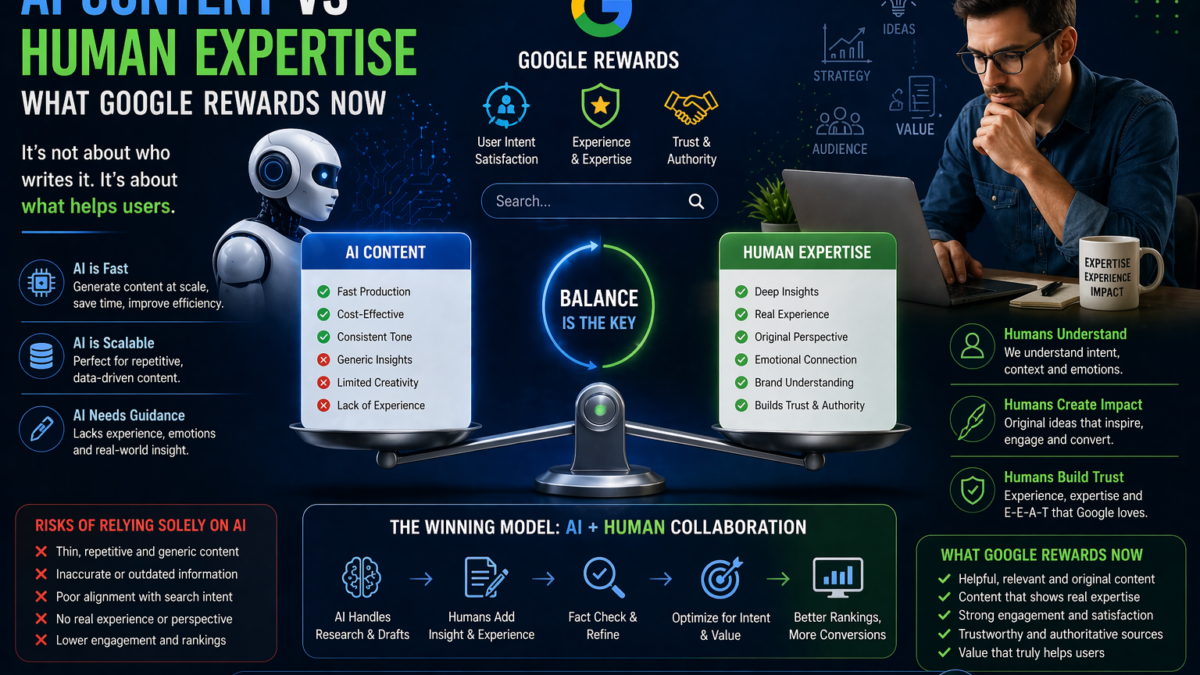
The rapid rise of artificial intelligence has transformed how digital content is created, scaled, and optimized. From automated blog writing to AI-generated product descriptions, businesses now have access to tools that can produce large volumes of content in a fraction of the time it once took. This shift has sparked a critical question across the SEO industry: does AI-generated content outperform human-written content, or does human expertise still hold the advantage?
In 2026, search engines are no longer impressed by volume alone. Instead, they prioritize usefulness, trust, and real value for users. This evolution has reshaped how SEO strategies are planned and executed, particularly for businesses competing in saturated markets like India. For brands working with top SEO companies or a seasoned SEO consultant, understanding how AI and human expertise fit into modern search is no longer optional it is essential.
This blog explores how search engines evaluate AI content versus human expertise today, what actually drives rankings, and how professional SEO services can balance technology with strategic insight to achieve sustainable growth.
The Rise of AI Content in SEO
AI content tools have become widely accessible, allowing businesses to generate articles, landing pages, and e-commerce descriptions at scale. These tools excel at pattern recognition, summarization, and language generation, making them efficient for producing structured, keyword-aligned content.
For SEO services, AI has introduced undeniable efficiency. Keyword clustering, topic ideation, meta description generation, and even content outlines can now be completed in minutes. For large websites, especially e-commerce platforms, this scalability can be a significant advantage.
However, efficiency does not automatically translate into rankings. Search engines evaluate more than syntax and keyword usage. They assess meaning, intent satisfaction, originality, and trustworthiness. This is where the gap between AI-generated content and human expertise becomes clear.
How Google Evaluates Content Today
Modern search algorithms are built to assess quality at a much deeper level than before. Rather than asking whether content is written by a human or a machine, they evaluate whether the content genuinely helps users. Google has consistently emphasized that high-quality content must demonstrate experience, expertise, authority, and trust.
This means that content created purely to rank, without real insight or value, struggles to perform—regardless of whether it is written by AI or humans. Pages that feel generic, repetitive, or shallow are easily identified and deprioritized.
Search systems now analyze how users interact with content. If users leave quickly, fail to engage, or do not find answers, rankings decline over time. This shift has made human understanding of audience behavior more important than ever.
Where AI Content Performs Well
AI-generated content is not inherently ineffective. In fact, when used correctly, it can support SEO efforts in meaningful ways. AI performs best in areas where structure and consistency matter more than originality.
For example, AI can efficiently handle:
- Large-scale product descriptions for e-commerce platforms
- Basic informational content with low competition
- Content refreshes for outdated but factual pages
- Drafting content frameworks for further human refinement
In e-commerce SEO, AI can assist with categorizing products, generating schema-ready descriptions, and maintaining consistency across thousands of pages. When combined with expert oversight, this approach can save time without compromising quality.
However, AI alone rarely produces content that builds trust or authority. This limitation becomes evident in competitive niches where expertise and differentiation matter most.
The Limits of AI Without Human Expertise
While AI can replicate language patterns, it cannot replace lived experience, strategic judgment, or industry insight. It does not understand brand voice, cultural nuance, or business goals in the way humans do.
Search engines reward content that reflects real understanding. This includes original perspectives, nuanced explanations, and practical insights drawn from experience. AI-generated content often lacks these qualities unless guided by an expert.
Another challenge is accuracy and context. AI tools rely on existing data patterns and may produce outdated or oversimplified information. Without human review, this can harm credibility and trust, both of which directly influence SEO performance.
For businesses relying solely on automation, the result is often content that looks polished but feels empty. In competitive markets, such content rarely ranks for long.
Why Human Expertise Still Drives Rankings
Human expertise brings strategic depth that AI cannot replicate. A skilled SEO consultant understands search intent beyond keywords. They know why users search, what problems they are trying to solve, and how content should be structured to meet those needs.
Expert-led content demonstrates clarity, originality, and purpose. It connects topics logically, addresses objections, and anticipates follow-up questions. This depth signals authority to search engines and builds trust with users.
Top SEO companies increasingly use AI as a support tool rather than a replacement. Human strategists guide topic selection, refine messaging, and ensure alignment with brand goals. This combination produces content that is both efficient and impactful.
AI + Human Collaboration: The Winning Model
The most successful SEO strategies in 2026 are hybrid models. AI handles repetitive and time-consuming tasks, while humans focus on strategy, creativity, and quality control.
In this model, AI supports:
- Keyword research and clustering
- Content outlines and drafts
- Data analysis and performance insights
Human experts then:
- Define content strategy and intent alignment
- Add original insights and real-world examples
- Ensure accuracy, tone, and brand consistency
- Optimize internal linking and conversion pathways
This collaboration allows SEO services to scale without sacrificing quality. It also aligns perfectly with how search engines evaluate content today.
What This Means for E-Commerce SEO
E-commerce websites face unique challenges. Thousands of similar product pages compete for visibility, and thin or duplicate content can quickly harm performance. AI can help generate baseline content, but human expertise is essential for differentiation.
For businesses offering e-commerce SEO services, the focus is no longer just on indexing products but on building category authority. This requires thoughtful content that explains use cases, comparisons, buying guides, and trust signals.
A professional SEO services provider ensures that AI-generated elements are enhanced with strategic insights, internal linking, and user-focused optimization. This approach improves both rankings and conversions.
Why Businesses Still Need Professional SEO Services
As algorithms grow more sophisticated, SEO has become less about tactics and more about understanding systems. Businesses increasingly turn to top SEO companies not just for execution, but for guidance on how technology and human expertise should work together.
A reliable SEO consultant evaluates where automation adds value and where human input is essential. They align content creation with long-term goals rather than chasing short-term traffic spikes.
Professional SEO services also provide accountability. Performance is monitored, content is refined, and strategies are adjusted based on real data. This ongoing optimization is something AI alone cannot manage effectively.
The Indian Market and Content Quality
In India’s highly competitive digital environment, content quality has become a key differentiator. Multilingual audiences, mobile-first users, and price-sensitive markets demand clarity and trust.
Businesses that rely on generic AI content often struggle to connect with users. In contrast, those that invest in expert-driven content supported by AI tools see stronger engagement and more stable rankings.
This is why many Indian brands prioritize SEO services that emphasize quality, relevance, and experience over automation alone.
The Future of AI Content and SEO
AI will continue to evolve, becoming more accurate and context-aware. However, search engines will evolve alongside it, refining their ability to detect value, originality, and trust.
The future of SEO is not about choosing between AI and humans. It is about integration. Brands that understand this balance will outperform those that rely too heavily on either side.
Human expertise will remain the guiding force behind strategy, creativity, and trust-building, while AI will enhance efficiency and scalability.
Conclusion
In 2026, search engines reward content that genuinely serves users. AI content can support SEO efforts, but it cannot replace human expertise. Rankings are driven by relevance, depth, authority, and experience—qualities that require strategic thinking and real understanding.
For businesses seeking sustainable growth, the smartest approach is collaboration. AI handles the mechanics, while humans shape the message and strategy. This balance is what modern SEO services are built on.
Whether working with a trusted SEO consultant or one of the top SEO companies, brands that prioritize quality over shortcuts are best positioned for long-term success in search.
FAQ
Does Google penalize AI-generated content?
No. Search engines do not penalize content simply because it is AI-generated. They evaluate quality, usefulness, and trustworthiness.
Can AI content rank without human editing?
In low-competition niches, it may rank temporarily. In competitive markets, human refinement is essential for sustained performance.
Is human-written content always better than AI content?
Not always. The best results come from combining AI efficiency with human expertise and strategic oversight.
Why do businesses still hire SEO consultants if AI tools exist?
Because SEO is about strategy, intent, and long-term planning. AI supports these efforts but cannot replace expert judgment.
How should businesses use AI responsibly in SEO?
AI should be used as a tool for efficiency, not a substitute for expertise. Human review, originality, and user focus are critical.
Leave a Reply