
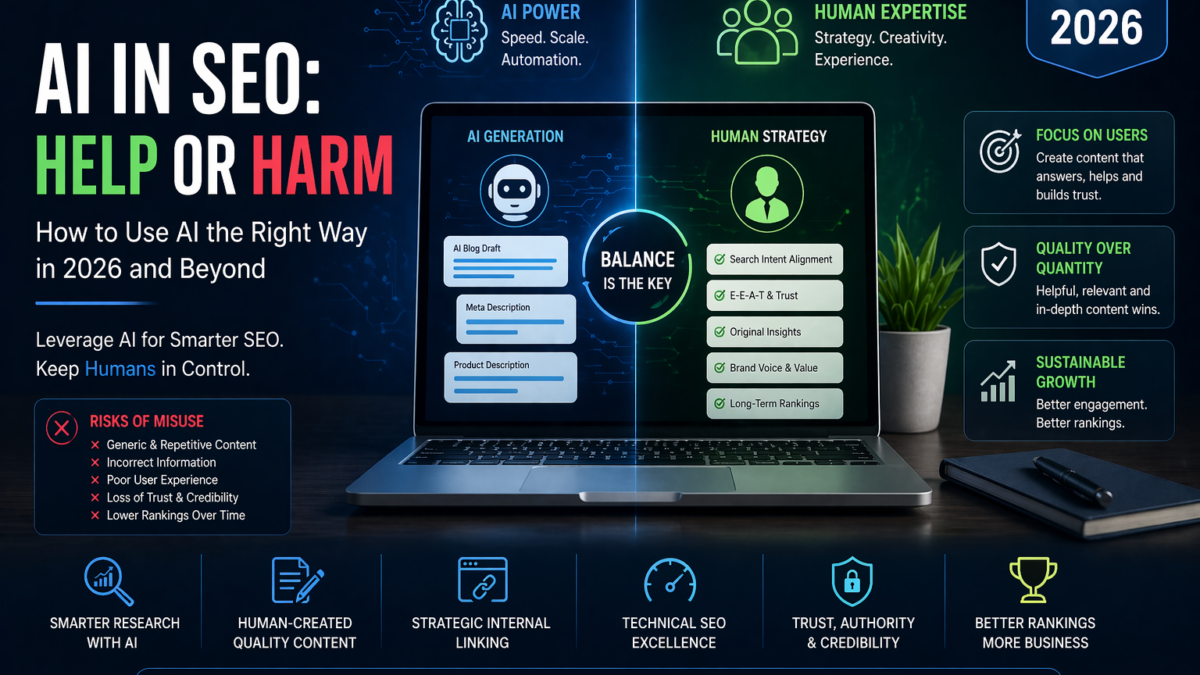
Artificial intelligence has rapidly reshaped the SEO landscape. From automated keyword research to AI-generated blogs and product descriptions, businesses now have access to tools that promise faster results with less effort. For many brands, especially those working with top SEO companies or hiring an experienced SEO consultant, AI seems like the shortcut to higher rankings and lower costs.
However, the reality in 2026 is far more nuanced. While AI can accelerate execution, improper use can dilute content quality, damage trust, and ultimately hurt search rankings. Search engines have evolved beyond rewarding sheer volume. They now prioritize relevance, experience, authority, and genuine usefulness.
The Growing Role of AI in Modern SEO
AI has become deeply embedded in SEO workflows. Tools now assist with keyword clustering, competitor analysis, content outlines, internal linking suggestions, and even predictive performance insights. For businesses managing large websites, this efficiency is appealing.
For example, in e-commerce SEO, AI can help generate thousands of baseline product descriptions, optimize meta tags at scale, and organize category hierarchies more efficiently than manual methods. This scalability is one reason many top SEO companies have integrated AI into their processes.
But AI’s strength lies in processing patterns, not understanding intent or business context. It can identify what words appear together, but it does not truly understand why users search or what makes content trustworthy. Without human direction, AI-driven SEO often becomes mechanical rather than meaningful.
How Search Engines Evaluate Content in 2026
Search engines today focus on outcomes, not methods. They do not ask whether content was written by AI or a human. Instead, they evaluate whether the content satisfies user intent and delivers real value.
Signals such as engagement, dwell time, topical depth, internal consistency, and credibility play a central role. Algorithms increasingly analyze how content connects to broader topical authority and whether it demonstrates real expertise.
Google has repeatedly emphasized that helpful content is content created for people, not for algorithms. Pages that feel generic, repetitive, or purely keyword-driven are less likely to perform, even if they are technically optimized.
This is why blind automation often fails. AI can generate text, but it cannot independently ensure usefulness, originality, or trust.
Where AI Helps SEO Without Risk
When used strategically, AI can strengthen SEO rather than weaken it. The key is to apply AI where structure and efficiency matter more than originality or judgment.
AI works well for:
- Keyword research and semantic clustering
- Content briefs and outlines
- Updating outdated factual content
- Generating structured data ideas
- Scaling repetitive e-commerce descriptions (with oversight)
In e-commerce SEO, AI can support large catalogs by maintaining consistency across product pages. When a human expert reviews and refines this output, the result is scalable yet reliable content.
Professional SEO services often use AI in this supportive role speeding up execution while keeping strategy firmly human-led.
How AI Can Damage Rankings If Misused
Problems arise when AI is treated as a replacement rather than a tool. Fully automated content pipelines often produce pages that look polished but lack depth, differentiation, or accuracy.
Common risks include:
- Thin content that repeats what already exists online
- Inaccurate or outdated information
- Poor alignment with search intent
- Loss of brand voice and credibility
- Over-optimization that feels unnatural
Search engines quickly identify patterns of low-value content, especially on large sites. Rankings may initially rise due to freshness or keyword coverage, but they often decline once engagement signals reveal poor user satisfaction.
This is where businesses that skip professional SEO services often struggle. Automation without strategy leads to short-term gains and long-term losses.
Why Human Expertise Still Matters in SEO
Human expertise remains the core driver of sustainable SEO success. A skilled SEO consultant understands user psychology, competitive landscapes, and business objectives elements AI cannot independently grasp.
Human-led SEO ensures:
- Accurate interpretation of search intent
- Strategic topic selection and content depth
- Logical internal linking and site architecture
- Brand-aligned messaging and tone
- Ethical, long-term optimization decisions
Expert-written or expert-refined content feels purposeful. It anticipates user questions, explains nuances, and offers insights that go beyond surface-level information. These qualities build trust, which search engines increasingly reward.
This is why top SEO companies position AI as an assistant, not an author.
The Hybrid Model: AI + Human Strategy
The most effective SEO strategies in 2026 follow a hybrid model. AI handles repetitive and data-heavy tasks, while humans guide direction, quality, and intent.
In this model:
AI supports efficiency by accelerating research, drafts, and analysis.
Human experts define strategy, ensure accuracy, and add insight.
Professional SEO services rely on this balance. AI reduces turnaround time, but humans ensure content meets search quality standards and business goals.
This collaboration allows brands to scale content without sacrificing credibility or rankings.
AI in E-Commerce SEO: A Careful Balance
E-commerce websites face intense competition and thin margins for error. Duplicate or shallow content across product pages can quickly erode visibility.
AI can assist by generating structured descriptions, attribute-based content, and category-level summaries. However, human expertise is essential for:
- Differentiating categories with buying guides
- Adding trust signals and FAQs
- Optimizing for conversion, not just traffic
- Building topical authority around products
Businesses investing in professional SEO services for e-commerce benefit from AI’s speed combined with expert oversight. This approach improves both rankings and revenue.
Why Businesses Still Rely on SEO Consultants
Despite advanced AI tools, businesses continue to hire experienced SEO consultants because SEO is fundamentally strategic. It involves trade-offs, prioritization, and long-term planning.
AI can suggest actions, but it cannot decide which opportunities align with brand goals or which risks are worth taking. A human expert evaluates data in context, adapts strategies, and ensures compliance with evolving search guidelines.
This is why top SEO companies remain in demand even as AI becomes more powerful.
The Indian Market and AI-Driven SEO
India’s digital market is highly competitive and diverse. Multilingual audiences, mobile-first behavior, and varying trust levels mean that generic AI content often fails to resonate.
Brands that succeed focus on clarity, relevance, and credibility. They use AI to support scale but rely on human insight to connect with users. High-quality SEO services in India increasingly emphasize this balance, helping brands stand out in crowded search results.
The Future of AI in SEO
AI will continue to evolve, offering better language generation and deeper data analysis. At the same time, search engines will refine their ability to detect value, originality, and trust.
The future of SEO is not automation versus humans. It is a collaboration. Brands that integrate AI responsibly under expert guidance will outperform those that chase shortcuts.
Conclusion
Using AI in SEO does not have to destroy rankings. When applied thoughtfully, AI enhances efficiency and scalability. When misused, it undermines trust and performance.
In 2026, rankings are driven by relevance, depth, and authority. AI can support these goals, but only human expertise can define them.
Businesses working with a reliable SEO consultant or partnering with top SEO companies that offer strategic SEO services are best positioned for sustainable growth. The winning formula is clear: let AI handle the mechanics, and let humans lead the strategy.
FAQ
Does Google penalize AI-generated content?
No. Search engines do not penalize content for being AI-generated. They evaluate quality, usefulness, and trustworthiness.
Can AI content rank without human editing?
It may rank temporarily in low-competition niches, but sustained performance usually requires human refinement.
Is human-written content always better than AI content?
Not always. The strongest results come from combining AI efficiency with human expertise.
Why do businesses still invest in SEO services if AI tools exist?
Because SEO is strategic. AI supports execution, but expert judgment drives long-term success.
How should AI be used responsibly in SEO?
As a tool, not a replacement always guided by human insight, originality, and user focus.
Leave a Reply