
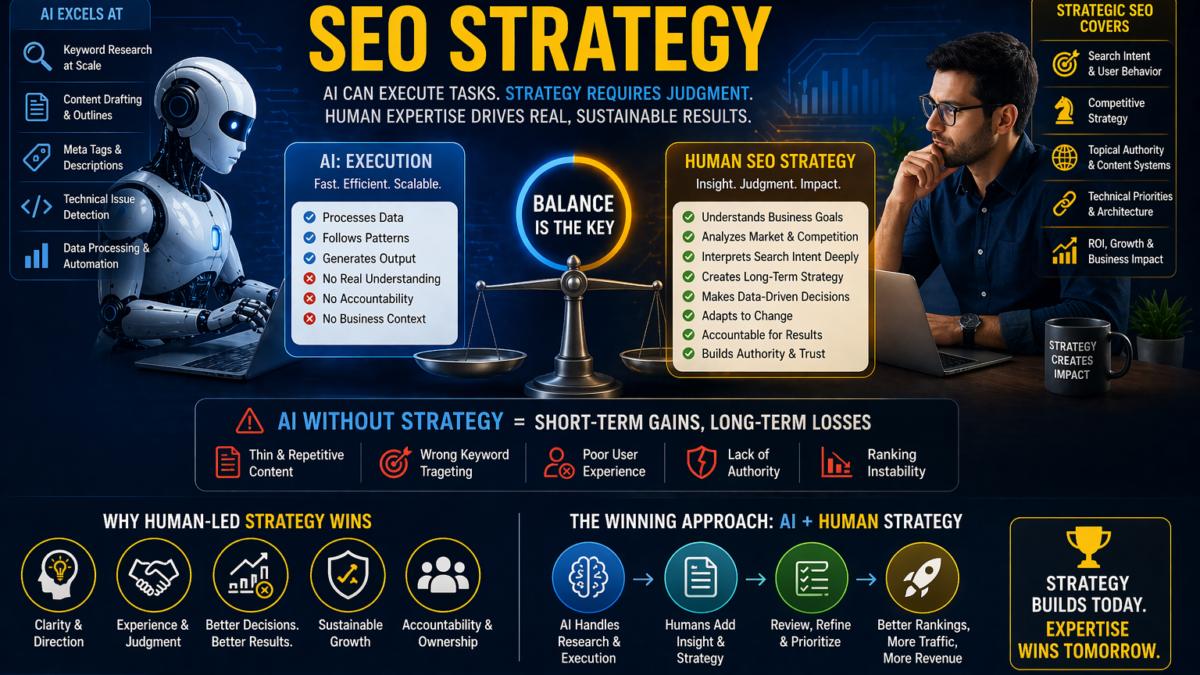
Artificial Intelligence has changed how SEO tasks are executed, but it has not changed how SEO success is achieved. Many businesses now believe that AI tools can replace SEO professionals entirely writing content, selecting keywords, building links, and fixing technical issues automatically. This belief is not only inaccurate, it is risky.
SEO is no longer about isolated actions. It is about systems, intent, authority, and long-term positioning. AI can process information faster than humans, but it cannot understand business goals, market dynamics, or competitive psychology. Strategy requires judgment, experience, and accountability qualities AI does not possess.
This blog explains why AI cannot replace SEO strategy, where businesses go wrong when they rely on automation alone, and why a consultant-led SEO consultancy remains essential in the AI era.
SEO Strategy Is Decision-Making, Not Task Execution
At its core, SEO strategy is about making the right decisions, not performing tasks faster.
Strategic SEO answers questions such as:
- Which keywords will generate revenue, not just traffic?
- Which pages should rank and which should not?
- How should authority flow across the website?
- What content builds long-term topical leadership?
- How should SEO align with sales, branding, and UX?
AI tools can execute instructions, but they cannot decide what matters most for a specific business. Without strategy, automation simply accelerates the wrong actions.
This is where professional SEO services outperform tool-driven approaches.
AI Operates on Patterns, Not Purpose
AI models are trained on historical data. They identify patterns, predict language, and replicate structures. What they do not understand is purpose.
Business goals change.
Markets evolve.
Competitors react.
User expectations shift.
AI does not recognize these shifts unless instructed and even then, it cannot interpret them holistically.
An SEO consultancy continuously adapts strategy based on:
- Market trends
- Competitive movements
- Algorithm updates
- User behavior
- Business priorities
AI alone cannot connect these variables into a coherent strategy.
Strategy Requires Understanding the Business, Not Just the Website
One of the biggest failures of AI-led SEO is treating websites as isolated entities.
Effective SEO strategy requires understanding:
- The business model
- Profit margins and high-value services
- Sales cycles and customer journeys
- Brand positioning
- Geographic and cultural context
For example, ranking for a high-volume keyword may look attractive, but if it does not convert or align with the business’s core offering, it is strategically useless.
A top SEO company aligns SEO decisions with business outcomes, not just search metrics.
Search Intent Is Strategic, Not Mechanical
AI can label keywords as informational, transactional, or navigational. Strategy goes much deeper.
SEO strategy involves:
- Mapping intent across the entire funnel
- Identifying intent shifts over time
- Recognizing implicit commercial signals
- Avoiding keyword cannibalization
- Designing content paths that guide users
These decisions require interpretation, not classification.
AI may suggest hundreds of keywords, but it cannot determine which ones deserve priority based on ROI, competition, and brand goals.
Why Automation Alone Leads to Ranking Instability
Many AI-driven SEO efforts show early gains followed by stagnation or decline. This happens because automation lacks restraint.
Common automation mistakes include:
- Publishing too much content too quickly
- Creating overlapping pages targeting similar keywords
- Ignoring internal linking hierarchy
- Treating SEO as volume-based output
- Failing to build real authority
Search engines increasingly detect pattern-based behavior. When content looks automated, lacks differentiation, or adds no new value, rankings suffer.
An SEO consultancy applies control, pacing, and quality thresholds that automation cannot self-regulate.
Algorithm Changes Demand Strategic Interpretation
Search engines evolve constantly. Algorithm updates rarely come with exact instructions. They require interpretation.
Google updates focus on:
- Content quality
- Experience and trust
- Spam prevention
- User satisfaction
AI tools can detect volatility, but they cannot determine why performance changed or how to respond safely.
Human strategists analyze patterns, test hypotheses, and adjust direction without overreacting. This adaptability is critical to long-term SEO success.
SEO Is About Trade-Offs AI Avoids Them
Every SEO decision involves trade-offs:
- Speed vs quality
- Volume vs depth
- Authority vs reach
- Short-term wins vs long-term stability
AI tends to optimize for completion, not consequence. It does not weigh opportunity cost or risk exposure.
SEO strategy requires choosing what not to do just as much as choosing what to do. This restraint protects rankings and brand reputation.
Professional SEO services exist to manage these trade-offs responsibly.
Content Strategy Is a System, Not a Prompt
AI excels at producing individual pieces of content. SEO strategy designs ecosystems.
A strong content strategy includes:
- Topic clusters
- Pillar-page architecture
- Internal authority distribution
- Content refresh cycles
- Competitive displacement planning
Without strategy, AI content becomes isolated assets with no cumulative power.
An SEO consultancy ensures every piece of content strengthens the whole system, not just its own page.
Technical SEO Decisions Are Strategic Choices
AI tools can identify technical issues, but they cannot decide priority or impact accurately.
Examples:
- Fixing crawl budget issues vs content expansion
- Speed optimization trade-offs with design
- JavaScript rendering decisions
- URL restructuring risks
Incorrect technical decisions can damage rankings site-wide.
A top SEO company evaluates technical SEO through the lens of scalability, risk, and business growth not just tool recommendations.
AI Cannot Be Accountable
When SEO fails, accountability matters.
AI does not:
- Take responsibility for ranking drops
- Explain strategic decisions
- Adapt based on stakeholder feedback
- Balance SEO with brand and legal risks
SEO strategy requires ownership. Businesses need advisors who stand behind decisions and refine them over time.
This is why consultant-led SEO continues to outperform automation-only models.
The Role of AI in a Strategic SEO Framework
AI absolutely has a place in modern SEO but not as a strategist.
Used correctly, AI supports:
- Data processing
- Pattern identification
- Draft creation
- Performance monitoring
Used incorrectly, it replaces thinking with output.
The difference lies in leadership. Strategy must always remain human-led.
Conclusion
AI is a powerful tool, but it is not a strategist. SEO success depends on judgment, context, experience, and long-term vision elements no algorithm can replicate.
Businesses that rely solely on AI for SEO may gain speed, but they lose direction. Rankings without strategy are unstable, traffic without intent is unprofitable, and automation without oversight is risky.
An experienced SEO consultancy ensures that AI is used as an advantage, not a liability. In an increasingly automated digital world, strategy not software remains the ultimate competitive edge.
FAQs
1. Can AI replace SEO strategists?
No. AI can execute tasks but cannot make strategic decisions aligned with business goals.
2. Why do AI-driven SEO efforts often fail?
Because they focus on volume and automation rather than intent, authority, and long-term planning.
3. Is SEO strategy still important with AI tools available?
More than ever. AI increases complexity, making strategic oversight essential.
4. What role should AI play in SEO?
AI should support research and execution while humans handle strategy and decision-making.
5. Can AI handle competitive SEO markets?
Not alone. Competitive SEO requires judgment, adaptability, and experience.
6. Are professional SEO services still necessary?
Yes. Tools do not replace expertise, accountability, or business alignment.
7. How do top SEO companies use AI?
They integrate AI into structured strategies without replacing human leadership.
8. What happens if SEO lacks strategy?
Rankings become unstable, content underperforms, and long-term growth stalls.
Leave a Reply