
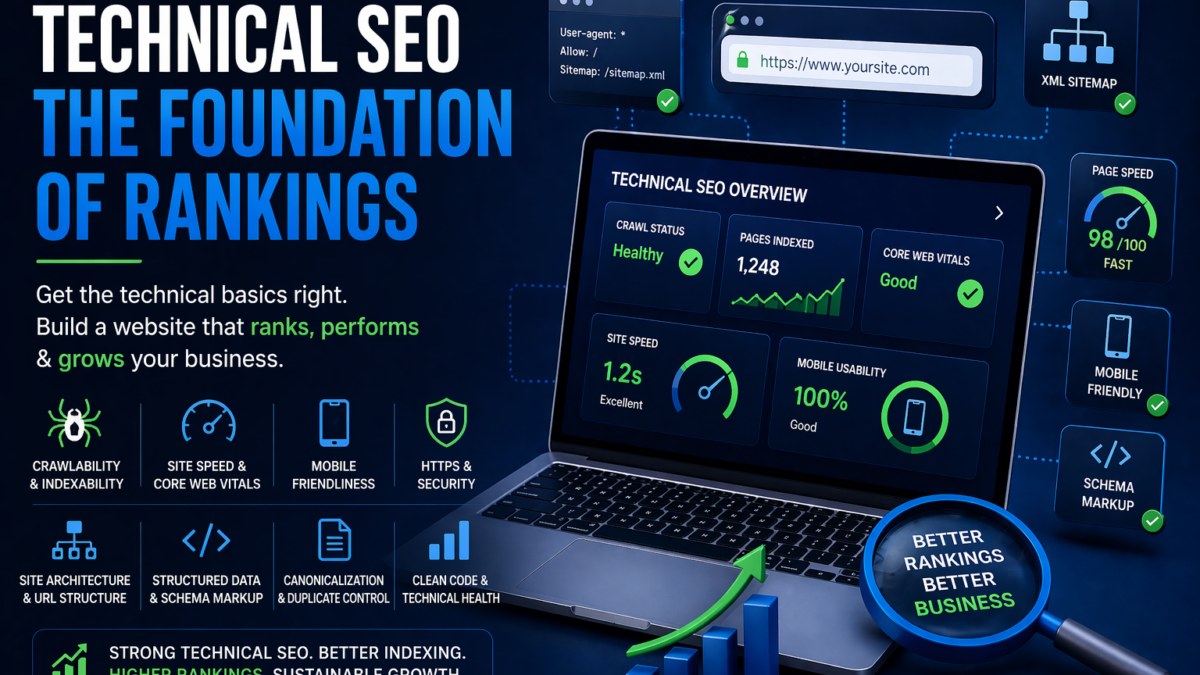
In today’s competitive digital environment, visibility on search engines is no longer optional it is essential for survival and growth. While content and backlinks often dominate SEO conversations, technical SEO quietly forms the foundation that supports every successful search strategy. Without strong technical SEO, even the most engaging content may fail to rank, be indexed properly, or deliver a smooth user experience. For businesses operating in India and beyond, getting the technical basics right is the difference between consistent organic growth and missed opportunities.
Technical SEO focuses on how search engines crawl, understand, and index your website. It ensures that your site is accessible, fast, secure, and structured in a way that both users and search engines can easily navigate. As algorithms become more sophisticated, technical SEO has shifted from a one-time setup task to an ongoing process that supports scalability and performance. This blog explores the core technical SEO basics every business must get right, explaining why they matter and how they contribute to long-term success.
What Is Technical SEO and Why It Matters
Technical SEO refers to optimizing the infrastructure of a website so that search engines can efficiently crawl, index, and rank its pages. Unlike on-page SEO, which focuses on content and keywords, technical SEO deals with backend elements such as site speed, mobile usability, security, and structured data.
When technical SEO is neglected, search engines may struggle to access your content, leading to poor rankings regardless of quality. For businesses seeking Affordable SEO services India, understanding technical SEO ensures that budgets are spent on strategies that create a strong foundation rather than temporary fixes.
Website Crawling and Indexability
Search engines use automated bots to crawl websites and discover content. If your site is not crawlable, it cannot be indexed, and if it is not indexed, it will not appear in search results. Ensuring proper crawlability is one of the most fundamental technical SEO requirements.
Key elements that influence crawling and indexability include:
- Robots.txt configuration to guide search engine bots
- XML sitemaps to help search engines find important pages
- Avoidance of duplicate or blocked URLs
- Proper use of canonical tags
A well-structured site allows search engines to focus on valuable pages instead of wasting crawl budget on irrelevant or duplicate content. Businesses working with an SEO expert in India often uncover hidden crawl issues that have silently limited their organic growth for years.
Site Architecture and URL Structure
Site architecture defines how pages are organized and linked together. A logical, hierarchical structure helps both users and search engines understand your website’s content. Poor architecture can confuse crawlers, dilute link equity, and reduce ranking potential.
Best practices for site architecture include:
- Clear category and subcategory structure
- Shallow page depth so important pages are easily accessible
- Clean, descriptive URLs without unnecessary parameters
- Consistent internal linking
A strong architecture not only improves rankings but also enhances user experience, making it easier for visitors to find information and convert. This is a critical focus area for any business guided by an SEO consultant India, as structural improvements often lead to measurable performance gains.
Page Speed and Core Web Vitals
Page speed is a confirmed ranking factor and a crucial user experience metric. Slow-loading websites frustrate users, increase bounce rates, and reduce conversions. Search engines reward fast, responsive websites because they deliver better experiences.
Technical SEO improvements for page speed typically address:
- Image optimization and compression
- Browser caching and server response time
- Minimizing JavaScript and CSS files
- Improving hosting and content delivery networks
Core Web Vitals further measure real-world user experience by evaluating loading performance, interactivity, and visual stability. Businesses that prioritize these metrics often see improvements in rankings, engagement, and revenue. Partnering with a reliable SEO company India helps ensure that speed optimizations are implemented correctly without breaking site functionality.
Mobile-Friendliness and Responsive Design
With mobile-first indexing, search engines primarily evaluate the mobile version of a website for ranking purposes. If your site does not perform well on mobile devices, your visibility will suffer regardless of desktop performance.
Mobile-friendly technical SEO ensures that:
- Content is easily readable on smaller screens
- Navigation is intuitive and touch-friendly
- Page speed remains fast on mobile networks
- Pop-ups and intrusive elements are minimized
Responsive design allows a single website to adapt seamlessly across devices, simplifying maintenance and improving consistency. Businesses that ignore mobile optimization risk losing both rankings and customers in an increasingly mobile-driven market.
Secure Website and HTTPS Implementation
Website security is a critical trust signal for users and search engines alike. HTTPS encrypts data transferred between users and servers, protecting sensitive information and improving credibility. Search engines have confirmed HTTPS as a ranking signal, making it a non-negotiable technical SEO requirement.
Beyond HTTPS, security best practices include regular software updates, secure hosting environments, and protection against malware or spam injections. A secure website builds trust, supports compliance, and reduces the risk of ranking losses due to security issues.
Duplicate Content and Canonicalization
Duplicate content occurs when similar or identical content appears on multiple URLs. This can confuse search engines, dilute ranking signals, and prevent the right page from ranking. Duplicate content issues often arise from URL parameters, pagination, or poor content management practices.
Canonical tags help search engines identify the preferred version of a page, consolidating ranking signals and avoiding confusion. Proper canonicalization ensures that your most important pages receive the visibility they deserve.
Structured Data and Schema Markup
Structured data helps search engines understand the context of your content by providing additional metadata. While it does not directly boost rankings, it enhances search appearance through rich results such as star ratings, FAQs, and product details.
Common structured data applications include:
- Business and organization information
- Product and pricing details
- Reviews and ratings
- FAQs and how-to content
Enhanced search results improve click-through rates and visibility, making structured data a valuable technical SEO enhancement for competitive industries.
International and Local SEO Technical Considerations
Businesses targeting multiple regions or languages must implement technical signals that guide search engines correctly. Hreflang tags, localized URLs, and region-specific content help search engines serve the right version of a site to the right audience.
Even businesses focusing on a single market benefit from local technical SEO elements such as accurate business information, location-based structured data, and optimized site performance for regional users. These signals strengthen relevance and trust in local search results.
Monitoring, Auditing, and Continuous Improvement
Technical SEO is not a one-time task. Websites evolve, content expands, and algorithms change. Regular audits are essential to identify new issues, monitor performance, and maintain compliance with best practices.
Ongoing monitoring typically includes:
- Crawl error analysis
- Index coverage tracking
- Performance and speed monitoring
- Security and usability checks
Consistent auditing ensures that technical SEO remains aligned with business growth and search engine expectations.
Conclusion
Technical SEO is the backbone of sustainable search performance. Without a solid technical foundation, content and marketing efforts struggle to deliver results. From crawlability and site architecture to speed, security, and structured data, every technical element plays a role in how search engines and users experience your website.
Businesses that invest in technical SEO position themselves for long-term success, scalability, and resilience against algorithm changes. By getting these basics right, organizations create an environment where content can thrive, users can engage, and organic growth can compound over time.
FAQ
What is technical SEO in simple terms?
Technical SEO focuses on optimizing the backend structure of a website so search engines can easily crawl, index, and rank its pages while providing a smooth user experience.
Is technical SEO necessary for small businesses?
Yes, technical SEO is essential for businesses of all sizes because even small websites can suffer from crawl issues, slow speed, or mobile usability problems that limit visibility.
How often should technical SEO audits be done?
Most businesses benefit from a technical SEO audit every three to six months, or whenever major website changes are made.
Can technical SEO alone improve rankings?
Technical SEO creates the foundation for rankings, but it works best when combined with strong content and ethical link-building strategies.
Do technical SEO improvements show immediate results?
Some improvements, such as fixing crawl errors or improving speed, can lead to quicker gains, while others support gradual, long-term growth over time.
Leave a Reply