
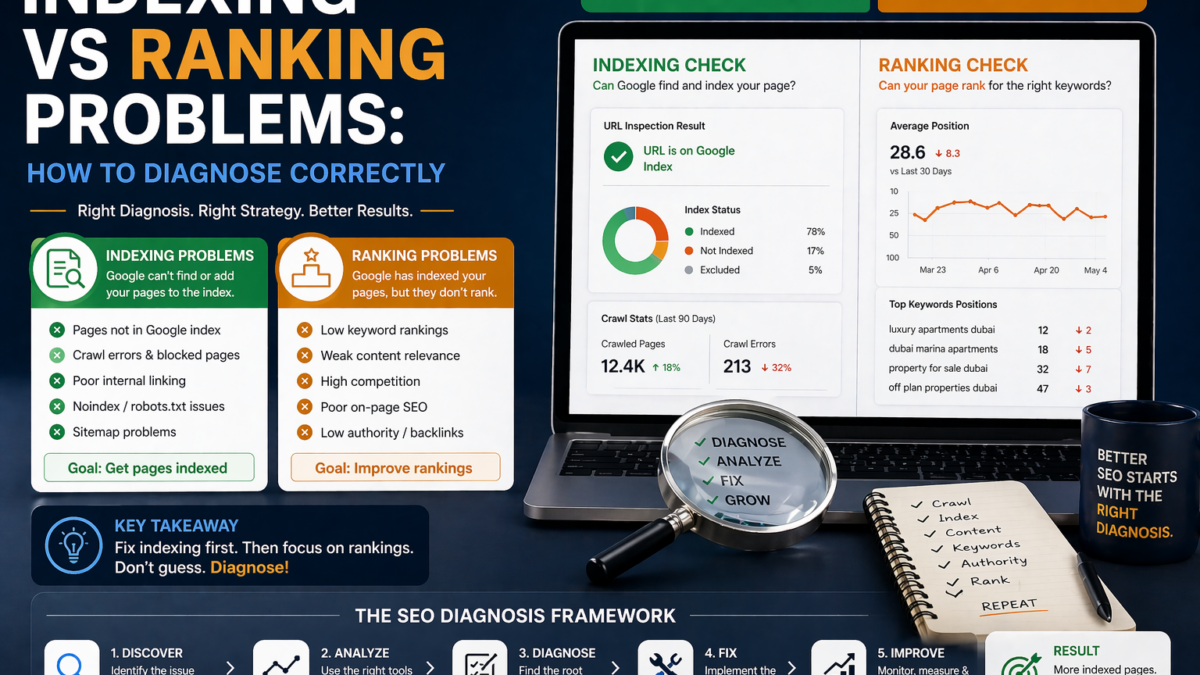
One of the most common and costly SEO mistakes businesses make is confusing indexing problems with ranking problems. Pages that don’t appear in search results are often assumed to be “penalized” or poorly optimized, when in reality they may not be indexed properly at all. Conversely, pages that are indexed but not ranking are frequently treated as technical issues, even though the root cause is strategic.
In 2026, as search engines become more selective and AI-driven, diagnosing the right problem matters more than ever. Fixing ranking signals won’t help pages that aren’t indexed, and improving crawlability won’t push weak pages to the top of competitive SERPs.
This blog breaks down the difference between indexing and ranking issues, explains how to diagnose them accurately, and outlines a structured approach to solving each without wasting time or resources.
Understanding the SEO Pipeline
Before diagnosing problems, it’s essential to understand how search engines process a page.
The simplified pipeline looks like this:
- Crawling – Search engines discover the page
- Indexing – The page is stored and evaluated
- Ranking – The page competes for visibility
If a page fails at any stage, it won’t generate traffic. The key is identifying where the failure occurs.
What Is an Indexing Problem?
An indexing problem occurs when a page is:
- Not added to the search engine index at all
- Removed from the index
- Indexed incorrectly (wrong canonical, version, or signals)
In these cases, ranking optimization is irrelevant because the page isn’t eligible to rank.
Common Causes of Indexing Issues
Indexing failures are usually technical or structural.
Typical causes include:
- Noindex directives
- Canonical pointing to another URL
- Blocked by robots.txt
- Crawl budget limitations
- Duplicate or near-duplicate content
- Low perceived value by search engines
Many websites unknowingly create thousands of index-resistant pages through CMS defaults or poor URL management.
What Is a Ranking Problem?
A ranking problem occurs when a page:
- Is indexed
- Appears for some queries
- But ranks too low to drive traffic
This means the page is eligible to compete but loses.
Ranking problems are strategic, not technical.
Common Causes of Ranking Issues
Ranking challenges usually stem from:
- Weak search intent alignment
- Insufficient topical authority
- Poor internal linking support
- Low engagement signals
- Stronger competitors with better content or trust
At this stage, technical fixes alone won’t move the needle.
The Most Common Misdiagnosis
One of the biggest SEO errors is applying ranking fixes to indexing problems.
Examples:
- Adding more keywords to a page that isn’t indexed
- Building backlinks to URLs blocked from indexing
- Updating content that search engines ignore
This is why businesses investing in Professional SEO services emphasize diagnosis before execution.
How to Diagnose Indexing vs Ranking Correctly
The diagnosis process should follow a strict order.
Step 1: Confirm Index Status
Ask one simple question first:
Is the page indexed?
If the answer is no, stop. You are dealing with an indexing issue.
If yes, move to ranking diagnostics.
Diagnosing Indexing Problems
Once indexing is the issue, look for signals such as:
- Page discovered but not indexed
- Crawled but not currently indexed
- Indexed but wrong URL selected
Root causes usually fall into:
- Technical exclusion
- Content duplication
- Low quality or low trust signals
Search engines increasingly choose not to index pages they deem unhelpful—even if technically accessible.
Why “Crawled but Not Indexed” Is Increasing
By 2026, search engines actively filter content at scale.
Reasons include:
- Thin content at scale
- Auto-generated or templated pages
- Low engagement history
- Redundant informational value
Indexing is now earned, not guaranteed.
Diagnosing Ranking Problems
If a page is indexed but underperforming, shift focus.
Key ranking diagnostics include:
- Search intent mismatch
- Competitive gap analysis
- Content depth comparison
- Authority and trust signals
At this stage, improving crawlability won’t help you must outperform competing pages.
Search Intent Misalignment: The Silent Killer
Many ranking failures happen because content answers the wrong question.
Examples:
- Informational content targeting transactional queries
- Product pages ranking for research-based searches
- Generic pages competing against niche intent
Search engines reward precision, not coverage.
Authority and Context Matter More Than Keywords
Ranking is no longer about keyword density.
Search engines evaluate:
- Topical depth across the site
- Internal linking context
- External credibility
- Brand trust signals
This is why sites working with the Best SEO company focus on authority building rather than isolated optimizations.
Internal Linking: The Overlooked Ranking Lever
Even well-written pages fail when they lack internal support.
Internal links help search engines understand:
- Page importance
- Topical relationships
- Hierarchical relevance
Ranking issues often resolve once internal authority is redistributed correctly.
When Indexing and Ranking Problems Overlap
Some cases involve both.
Examples:
- Partially indexed content clusters
- Pages indexed but suppressed due to duplication
- Large sites with crawl and ranking inefficiencies
These require coordinated technical and strategic fixes.
Enterprise Sites: Why Diagnosis Is Harder
Large websites complicate diagnosis because:
- Thousands of URLs behave differently
- Indexation can vary by template
- Crawl budget influences visibility
This is why a Top SEO agency relies on data segmentation, not assumptions.
Fixing Indexing Problems the Right Way
Effective indexing fixes include:
- Reducing duplicate URLs
- Improving canonical consistency
- Strengthening internal links
- Enhancing content uniqueness and value
- Pruning low-quality pages
The goal is to make indexing the obvious choice for search engines.
Fixing Ranking Problems the Right Way
Ranking improvements require:
- Better intent alignment
- Deeper, experience-based content
- Stronger topical clusters
- Enhanced user engagement
- Trust and authority reinforcement
Shortcuts rarely work in competitive environments.
Why Patience Matters in Diagnosis
Indexing changes can take weeks.
Ranking improvements can take months.
Constantly switching strategies resets progress and creates false conclusions.
Long-Term SEO Success Depends on Correct Diagnosis
SEO failures are rarely caused by a lack of effort.
They are caused by solving the wrong problem.
Correct diagnosis:
- Saves time and budget
- Prevents unnecessary technical changes
- Aligns strategy with reality
Conclusion
Indexing and ranking problems may look similar on the surface, but they require completely different solutions. In 2026, search engines are selective, strategic, and value-driven. Pages must first earn inclusion, then earn visibility.
Understanding where your SEO pipeline breaks is the difference between stagnation and scalable growth. Diagnose correctly, fix deliberately, and let performance compound over time.
FAQs
1. Can a page rank without being indexed?
No. Indexing is required before ranking is possible.
2. Why are my pages indexed but not ranking?
Usually due to intent mismatch, weak authority, or stronger competition.
3. How long does it take to fix indexing issues?
Anywhere from days to weeks, depending on crawl frequency and site size.
4. Do backlinks help with indexing?
They can help discovery but won’t guarantee indexing if content lacks value.
5. Should I update content before confirming index status?
No. Always confirm indexing first to avoid wasted effort.
Leave a Reply