
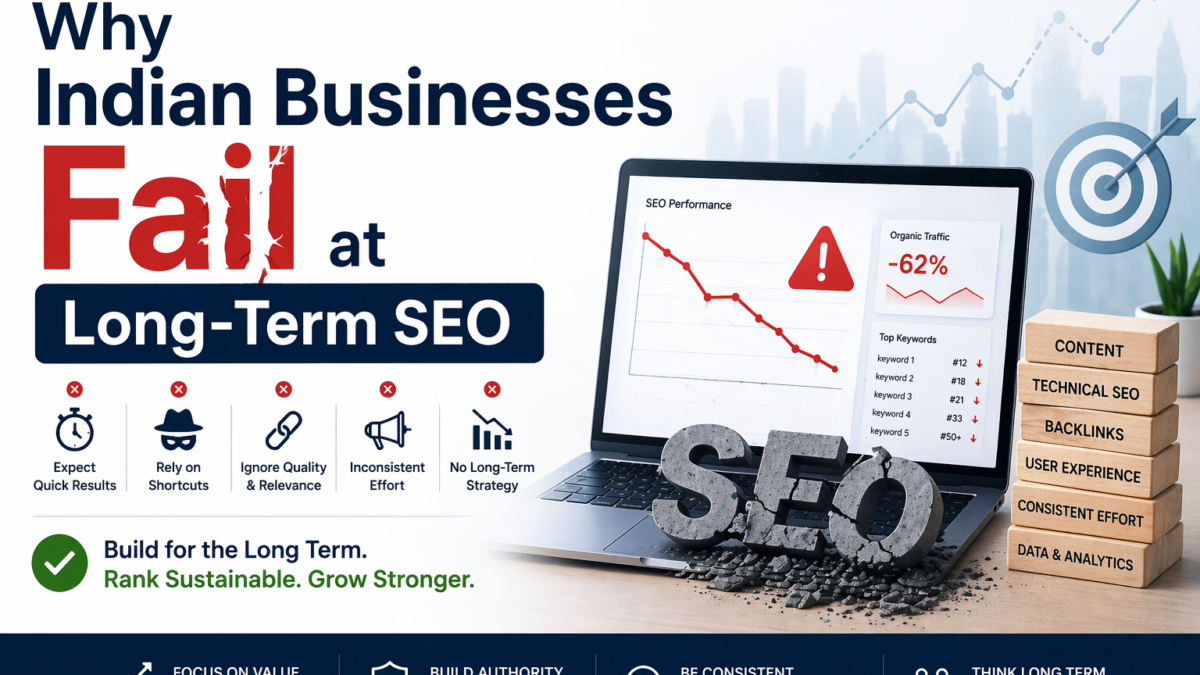
Search Engine Optimization is widely adopted by Indian businesses, yet long-term success remains rare. Many companies invest consistently in SEO but struggle to sustain rankings, traffic, or leads beyond a short period. Rankings rise briefly, only to drop after algorithm updates or competitive shifts. This pattern creates frustration and the belief that SEO is unreliable.
The reality is different. SEO itself is not failing execution and mindset are. By 2026, search engines have become highly sophisticated, rewarding consistency, intent alignment, and trust rather than volume-based tactics. Indian businesses that fail at long-term SEO often repeat the same strategic mistakes, regardless of industry or budget.
This blog explores the real reasons behind long-term SEO failure in India and outlines how businesses can shift toward sustainable, compounding organic growth.
The Misunderstanding of SEO as a Short-Term Activity
One of the most common causes of SEO failure in India is unrealistic expectation setting. SEO is still treated like a campaign rather than a system.
Many businesses expect:
- Rankings within weeks
- Immediate lead generation
- Guaranteed keyword positions
When these expectations are not met, strategies are abandoned prematurely. However, modern SEO is cumulative. Search engines reward patterns of value creation over time, not instant output.
By 2026, SEO success depends on patience, consistency, and long-term alignment with user needs.
Mistake 1: Chasing Rankings Instead of Business Outcomes
Indian businesses often measure SEO success solely through keyword rankings. While rankings matter, they are no longer the primary indicator of SEO effectiveness.
What rankings alone fail to show:
- Whether traffic converts
- Whether users find value
- Whether brand trust is increasing
Search engines now prioritize behavioral signals. Pages that rank but fail to engage users eventually lose visibility.
Businesses that succeed long-term align SEO with:
- Lead quality
- Conversion intent
- Customer journey stages
This shift from vanity metrics to outcome-driven SEO is essential.
Mistake 2: Poor Content Foundations
Content remains central to SEO, but most Indian websites publish content without a clear framework.
Common content issues include:
- Generic blog topics copied from competitors
- Overuse of AI-generated articles without editorial depth
- Content written for keywords rather than users
By 2026, search engines evaluate content using experience-based and trust-based signals. Shallow or repetitive content cannot maintain rankings, regardless of optimization.
Successful businesses focus on:
- Industry expertise
- Real-world examples
- Comprehensive topic coverage
This is why professional SEO services in India increasingly emphasize content strategy over content volume.
Mistake 3: Ignoring User Experience and Engagement
SEO traffic is meaningless if users disengage immediately.
Indian websites frequently struggle with:
- Slow mobile performance
- Cluttered layouts
- Confusing navigation
- Poor readability
Search engines interpret poor engagement as dissatisfaction. High bounce rates and low interaction reduce a site’s long-term ranking potential.
In 2026, SEO and UX are inseparable. Websites must be built to guide users clearly, quickly, and intuitively.
Mistake 4: Inconsistent SEO Execution
Consistency is one of the strongest ranking signals and one of the weakest areas for Indian businesses.
Common consistency failures include:
- Publishing content irregularly
- Changing SEO vendors frequently
- Abandoning strategies mid-way
- Reacting impulsively to algorithm updates
Search engines reward stability. Websites that show consistent improvement over time outperform those that reset strategies repeatedly.
This is why businesses seeking the Best SEO company in India now prioritize long-term partnerships over short-term deliverables.
Mistake 5: Over-Reliance on Tools and Automation
SEO tools provide insights, but they do not create strategy.
Many Indian businesses:
- Optimize based purely on tool scores
- Publish content to satisfy checklists
- Follow automated suggestions blindly
By 2026, SEO requires judgment, context, and business understanding. Tools support execution, but strategic decisions must remain human-led.
Automation without intent results in mechanical websites that fail to connect with users.
Mistake 6: Weak Link and Authority Strategy
Link building is often misunderstood as a numbers game.
Common link-related mistakes:
- Buying low-quality backlinks
- Using irrelevant directories
- Ignoring brand mentions
Search engines now evaluate link relevance, context, and authenticity. Authority is earned through credibility, not volume.
A sustainable link strategy includes:
- Thought leadership
- Digital PR
- Industry recognition
This is where a Top SEO agency in India adds value by earning authority rather than manufacturing it.
Mistake 7: Treating SEO as Isolated from Business Strategy
SEO fails when it operates in isolation.
Common disconnects:
- SEO not aligned with sales messaging
- Content not reflecting customer pain points
- No coordination between SEO, branding, and UX
Search engines reward businesses that show coherence across platforms and touchpoints.
When SEO reflects real business value, it becomes resilient to algorithm changes.
The Cost of Long-Term SEO Failure
When SEO fails repeatedly, businesses face:
- Rising paid advertising costs
- Declining brand trust
- Lower organic lead quality
- Reduced digital competitiveness
SEO failure is not just a marketing issue it becomes a growth limitation.
How Indian Businesses Can Fix Long-Term SEO
To succeed sustainably, businesses must:
- Commit to long-term strategy
- Invest in content depth and experience
- Measure outcomes, not just rankings
- Align SEO with customer journeys
SEO is no longer about optimization it is about credibility.
Conclusion
Indian businesses fail at long-term SEO not because SEO is unpredictable, but because it is misunderstood. By 2026, SEO rewards businesses that demonstrate clarity, consistency, and value over time.
Those who treat SEO as a system not a shortcut build digital assets that compound, stabilize, and strengthen with every year.
FAQs
1. Why do SEO results disappear after initial success?
Because early gains are often driven by tactics rather than sustainable strategy. Without engagement and trust, rankings decline.
2. Is SEO still worth investing in for Indian businesses?
Yes. SEO delivers the highest long-term ROI when executed strategically and consistently.
3. How long does it take to see stable SEO results?
Typically 3–6 months for traction, with long-term stability developing over 9–12 months.
4. Can small businesses succeed at SEO in India?
Absolutely. Strategic focus and niche authority often outperform large budgets.
5. What is the biggest SEO mistake Indian companies make?
Expecting short-term results from a long-term discipline.
Leave a Reply