
As artificial intelligence becomes mainstream, a new skill has gained attention across digital marketing: prompt engineering. The ability to ask AI tools the “right” questions is now seen by many as the key to better content, faster SEO execution, and lower costs. Some businesses have even begun to assume that mastering prompts is equivalent to mastering SEO.
This assumption is flawed.
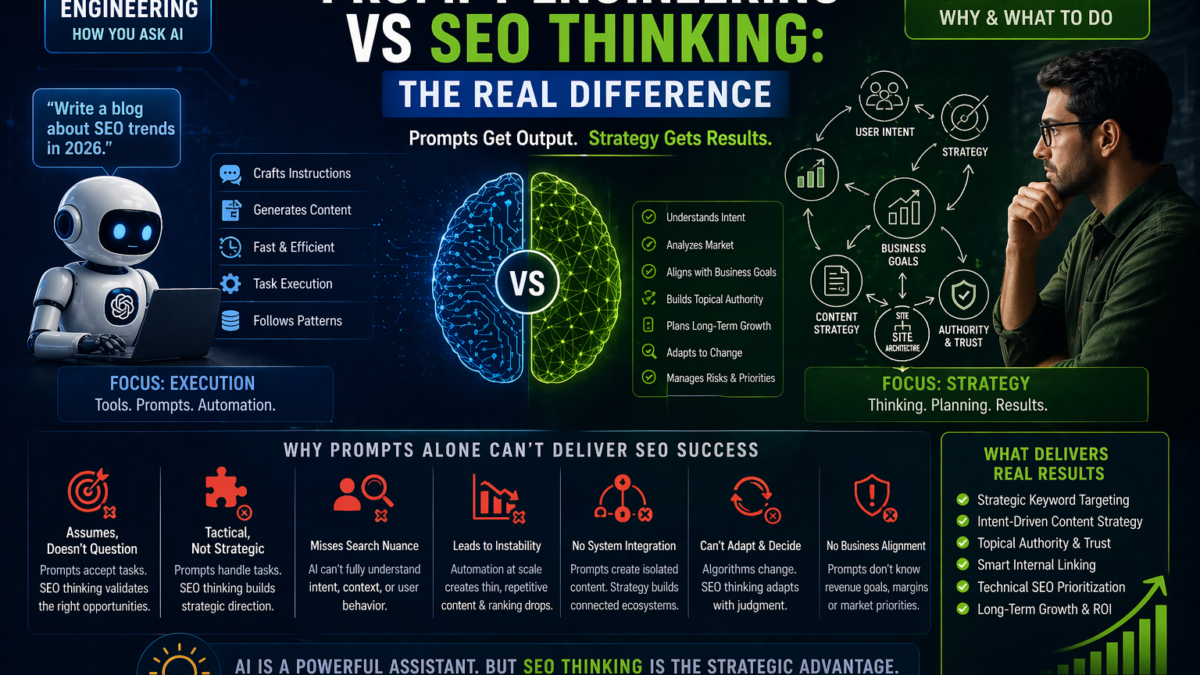
Prompt engineering is a technical skill. SEO thinking is a strategic discipline. One focuses on how to interact with machines; the other focuses on how search engines, users, markets, and businesses interact with each other. Confusing the two leads to automation-heavy SEO efforts that look sophisticated on the surface but fail to deliver sustainable rankings or business growth.
This blog explains the real difference between prompt engineering and SEO thinking, why prompts alone cannot replace strategy, and why businesses still need an SEO consultancy to succeed in the AI-driven search landscape.
What Prompt Engineering Actually Is
Prompt engineering is the practice of crafting structured instructions to guide AI tools toward better outputs. In SEO, this often includes prompts for:
- Blog outlines
- Meta descriptions
- Keyword variations
- Content rewrites
- FAQs and summaries
Well-written prompts can significantly improve efficiency and reduce manual effort. However, prompts only control how AI responds not why the output exists or whether it should exist at all.
Prompt engineering optimizes execution, not direction.
What SEO Thinking Really Means
SEO thinking is the ability to view search performance as a system rather than a collection of tasks.
It involves:
- Understanding user intent and behavior
- Interpreting algorithm signals
- Mapping content to business goals
- Designing site architecture and authority flow
- Anticipating competitive reactions
- Managing risk and long-term visibility
SEO thinking answers strategic questions before any content is created or optimized. Without it, even the most advanced prompts produce content that lacks purpose.
This distinction is why professional SEO services outperform prompt-driven automation.
Prompts Start With Assumptions SEO Thinking Questions Them
Every prompt assumes that the task is already correct.
For example:
“Write a 1,500-word blog targeting keyword X.”
Prompt engineering improves how the blog is written. SEO thinking first asks:
- Should this keyword be targeted at all?
- Is a blog the right format?
- Does this compete with an existing page?
- Is the intent informational or commercial?
- Will this content support conversions or authority?
AI cannot challenge assumptions. SEO strategists do.
A top SEO company prevents wasted effort by validating decisions before execution begins.
Prompt Engineering Is Tactical, SEO Thinking Is Strategic
Prompt engineering operates at the tactical layer:
- Content formatting
- Language refinement
- Structural consistency
SEO thinking operates at the strategic layer:
- Market positioning
- Opportunity prioritization
- Long-term authority building
Tactics without strategy lead to fragmented SEO efforts. Strategy without tactics is slow. Sustainable growth requires both but strategy must lead.
This is the foundation of consultant-led SEO.
Why Prompts Cannot Understand Search Intent Fully
Search intent is not static. It evolves with context, industry maturity, and user awareness.
AI prompts can categorize intent, but they cannot interpret:
- Mixed intent queries
- Funnel-stage transitions
- Local and cultural nuance
- B2B vs B2C decision complexity
For example, two keywords may look similar but require entirely different content strategies. Prompt engineering treats them as text problems. SEO thinking treats them as business opportunities.
This difference directly impacts rankings and conversions.
The Risk of Prompt-Led SEO at Scale
Many businesses now rely on prompt libraries to scale content rapidly. While this may increase output, it also introduces serious risks.
Common issues include:
- Keyword cannibalization
- Repetitive topical coverage
- Thin differentiation
- Weak internal linking logic
- Loss of topical authority
Search engines are increasingly effective at detecting pattern-based content production. When pages lack unique purpose, rankings flatten or decline.
An SEO consultancy applies governance, quality control, and strategic pacing—things prompts cannot self-manage.
SEO Thinking Integrates Across the Website
Prompts focus on individual outputs. SEO thinking designs systems.
SEO strategy considers:
- How pages support each other
- Which pages deserve authority
- How internal links distribute relevance
- Which content should be updated vs replaced
- How technical SEO supports content growth
Without this holistic view, AI-generated content becomes isolated assets with limited ranking power.
Professional SEO services ensure that every piece strengthens the overall ecosystem.
Algorithms Reward Strategy, Not Clever Prompts
Search engines evaluate patterns over time, not one-off optimizations.
Google rewards:
- Consistent topical depth
- Genuine usefulness
- Trust signals
- User satisfaction
- Long-term authority
Prompt engineering may produce well-written content, but without strategic cohesion, it fails to send strong ranking signals.
SEO thinking aligns content, structure, and intent into signals algorithms can trust.
Business Alignment Is Beyond AI’s Reach
SEO exists to support business growth, not just search visibility.
SEO thinking aligns with:
- Revenue priorities
- High-margin services
- Sales cycles
- Brand positioning
- Market expansion plans
Prompts do not understand profit margins or competitive strategy. They optimize text, not outcomes.
This is why businesses investing in professional SEO services see stronger ROI than those relying solely on AI-driven execution.
Prompt Engineering Without SEO Thinking Creates Noise
As more websites adopt AI, content quality benchmarks rise. What once ranked easily now requires depth and differentiation.
Prompt-only SEO creates:
- More content, not better content
- More pages, not more authority
- More keywords, not more conversions
SEO thinking filters noise and focuses effort where it matters most.
A top SEO company builds fewer, stronger assets not endless AI-generated pages.
The Right Relationship Between Prompts and Strategy
Prompt engineering is valuable but only when guided by strategy.
In effective SEO frameworks:
- Strategy defines goals
- SEO thinking sets priorities
- Prompts accelerate execution
- Humans review, refine, and optimize
- Performance data informs iteration
This hierarchy ensures AI works for the strategy, not against it.
Why SEO Consultants Matter More in the AI Era
AI has not simplified SEO it has intensified competition.
With everyone using similar tools:
- Strategy becomes the differentiator
- Judgment becomes the advantage
- Experience becomes the moat
An SEO consultancy provides clarity in an environment flooded with automation. Consultants decide what not to do, which is often more important than doing more.
Conclusion
Prompt engineering and SEO thinking are not interchangeable. One improves efficiency; the other determines success.
Prompts can help AI generate content, but they cannot define intent, evaluate risk, align with business goals, or build long-term authority. SEO thinking does all of that and more.
In the modern search landscape, the winners will not be those with the best prompts, but those with the strongest strategies. Businesses that combine AI efficiency with consultant-led SEO thinking will build rankings that last, traffic that converts, and brands that grow.
Automation may execute faster, but strategy decides direction. And in SEO, direction is everything.
FAQs
1. Is prompt engineering the same as SEO strategy?
No. Prompt engineering improves AI outputs, while SEO strategy defines goals, priorities, and long-term direction.
2. Can good prompts replace SEO experts?
No. Prompts cannot understand business context, intent nuance, or competitive dynamics.
3. Why do prompt-led SEO efforts fail?
They focus on output volume rather than strategic alignment, authority, and user value.
4. How should AI be used in SEO?
As a support tool for execution, guided by human-led SEO thinking and strategy.
5. Does Google reward AI-written content?
Google rewards helpful, authoritative content not automation itself.
6. What matters more: prompts or strategy?
Strategy. Prompts only work effectively when guided by clear SEO thinking.
7. Are professional SEO services still relevant?
More than ever. AI increases competition, making strategic expertise essential.
8. How do top SEO companies use AI differently?
They integrate prompts into structured strategies rather than letting automation dictate direction.
Leave a Reply