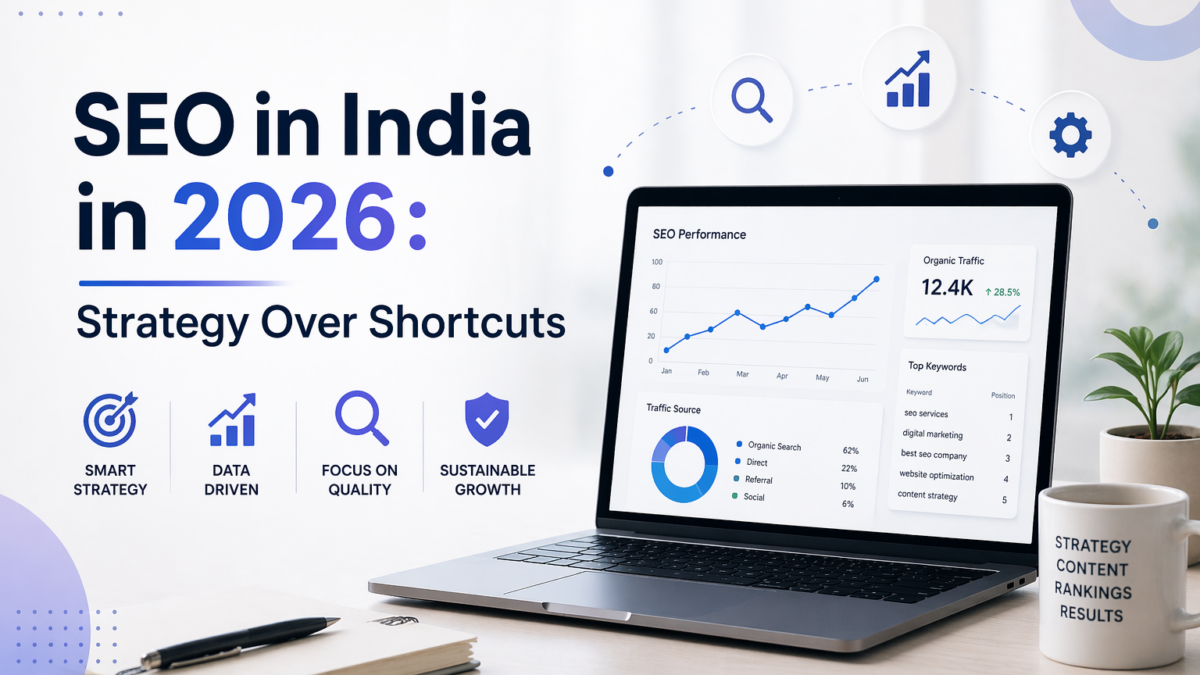
Search Engine Optimization in India has reached a critical turning point. By 2026, SEO is no longer a tactical marketing activity it is a strategic business investment. Indian businesses that once relied on rapid ranking tricks, mass link building, or automated content generation are discovering that these shortcuts no longer deliver sustainable results.
Search engines now operate as intelligent evaluation systems. They assess intent, credibility, experience, and long-term user satisfaction. In a market as competitive and diverse as India—where millions of websites compete across languages, cities, and industries—only strategy-driven SEO survives.
This blog explores how SEO in India has evolved by 2026, why shortcuts are failing, and how businesses can build resilient organic growth through structured, long-term strategy.
The Indian SEO Landscape: Then vs Now
A decade ago, SEO success in India often depended on:
- Ranking for high-volume keywords
- Acquiring large quantities of backlinks
- Publishing frequent but shallow content
These methods worked because algorithms were less sophisticated. By 2026, search engines interpret behavior, context, and trust signals with near-human accuracy.
Today, SEO success is defined by:
- Relevance, not repetition
- Authority, not activity
- Engagement, not impressions
Indian businesses that fail to recognize this shift often experience ranking instability, declining organic leads, and poor ROI.
Why SEO Shortcuts Are Failing in 2026
Shortcuts fail because they aim to manipulate systems that now evaluate outcomes, not inputs.
1. Algorithmic Maturity
Search engines now detect:
- Artificial backlink patterns
- Thin AI-generated content
- Over-optimized keyword usage
What once boosted rankings now triggers suppression or devaluation.
2. User Behavior as a Ranking Signal
Bounce rates, scroll depth, dwell time, and interaction patterns influence rankings directly. Shortcut-driven pages fail because they don’t satisfy real users.
3. Trust-Based Evaluation
Search engines assess whether a brand demonstrates consistency, expertise, and credibility over time. Short-term tactics leave no trust footprint.
Strategy-First SEO: What It Really Means
Strategy-first SEO aligns optimization with business objectives rather than algorithm speculation.
Pillar 1: Intent Mapping
Every page must answer a specific user intent:
- Informational
- Commercial
- Transactional
- Navigational
Indian search behavior is intent-heavy users want fast clarity, local relevance, and actionable answers.
Pillar 2: Topical Authority
Instead of isolated pages, strategy focuses on content ecosystems:
- Core pillar pages
- Supporting subtopics
- Internal contextual linking
This structure signals depth and expertise.
Pillar 3: Brand Signals
By 2026, SEO performance is influenced by brand perception:
- Mentions across platforms
- Review consistency
- Authorship transparency
This is why professional SEO services in India now integrate branding and content strategy rather than isolated optimization tasks.
Content Strategy in the Indian Market
India’s diversity makes generic content ineffective.
What Works in 2026:
- Industry-specific insights
- India-centric examples
- Region-aware messaging
Content must demonstrate lived experience, not just information.
What Fails:
- Rewritten global blogs
- Over-automated AI articles
- Keyword-stuffed service pages
Businesses ranking consistently focus on usefulness, not volume.
Technical SEO as a Strategic Asset
Technical SEO is no longer invisible infrastructure—it directly shapes user experience.
Key expectations in 2026:
- Mobile-first performance across devices
- Fast interaction times on low-bandwidth networks
- Logical site architecture for large content sets
A technically weak site nullifies even the best strategy.
Long-Term Compounding Advantage of Strategic SEO
Strategy-driven SEO delivers cumulative benefits:
- Stable keyword visibility
- Lower cost per acquisition
- Strong brand recall
This is why companies searching for the Best SEO company in India increasingly evaluate long-term planning capability rather than short-term ranking promises.
Common Strategic Mistakes Indian Businesses Still Make
- Treating SEO as a monthly checklist
- Separating SEO from content and UX
- Measuring success only through rankings
- Switching strategies too frequently
SEO rewards consistency more than experimentation.
The Business Impact of Strategy-Led SEO
When SEO is treated as a business function:
- Leads improve in quality
- Sales cycles shorten
- Paid marketing dependency reduces
A Top SEO agency in India in 2026 is defined not by tools used, but by strategic clarity delivered.
Conclusion
SEO in India in 2026 is no longer about outsmarting algorithms—it’s about aligning with them. Strategy has replaced shortcuts because search engines now reward the same qualities users value: relevance, trust, and experience.
Businesses that invest in structured SEO strategy today don’t just rank better—they build digital assets that grow stronger over time.
FAQs
1. Is SEO still effective in India in 2026?
Yes. SEO is more effective than ever, but only when executed as a long-term strategy rather than a shortcut-driven tactic.
2. Why do SEO shortcuts fail faster now?
Because search engines evaluate user behavior, trust signals, and content authenticity, not just keywords and links.
3. How long does strategic SEO take to show results?
Typically 3–6 months for measurable improvement, with compounding gains over time.
4. Can AI alone handle SEO in 2026?
No. AI supports execution, but strategy, judgment, and experience require human expertise.
5. What should Indian businesses prioritize first in SEO?
Intent-driven content, technical stability, and consistent brand credibility.
Leave a Reply